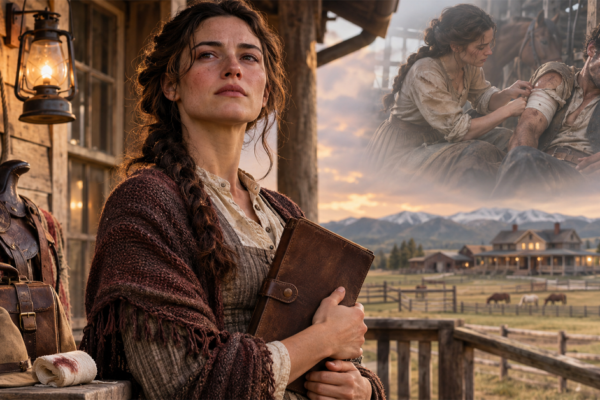
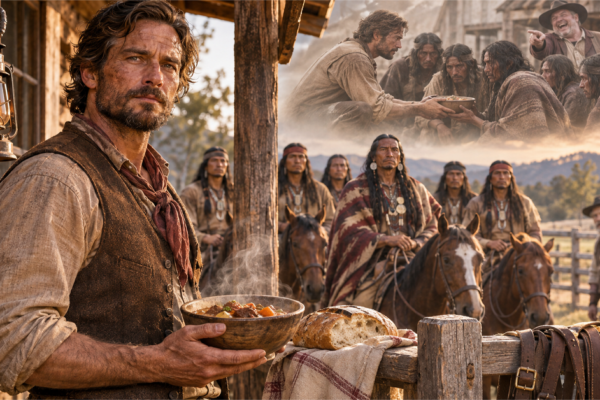
PART 2: A MAIL-ORDER BRIDE WAS ABANDONED IN A MONTANA BLIZZARD AND FOUND SHELTER IN A WIDOWER’S BARN. BUT WHEN RANCHER WYATT HOLLIS SAW THE WEATHERED LETTER CLUTCHED IN HER FROZEN HAND, HE RECOGNIZED HIS OWN HANDWRITING AND MADE A DECISION THAT WOULD CHANGE BOTH OF THEIR LIVES.
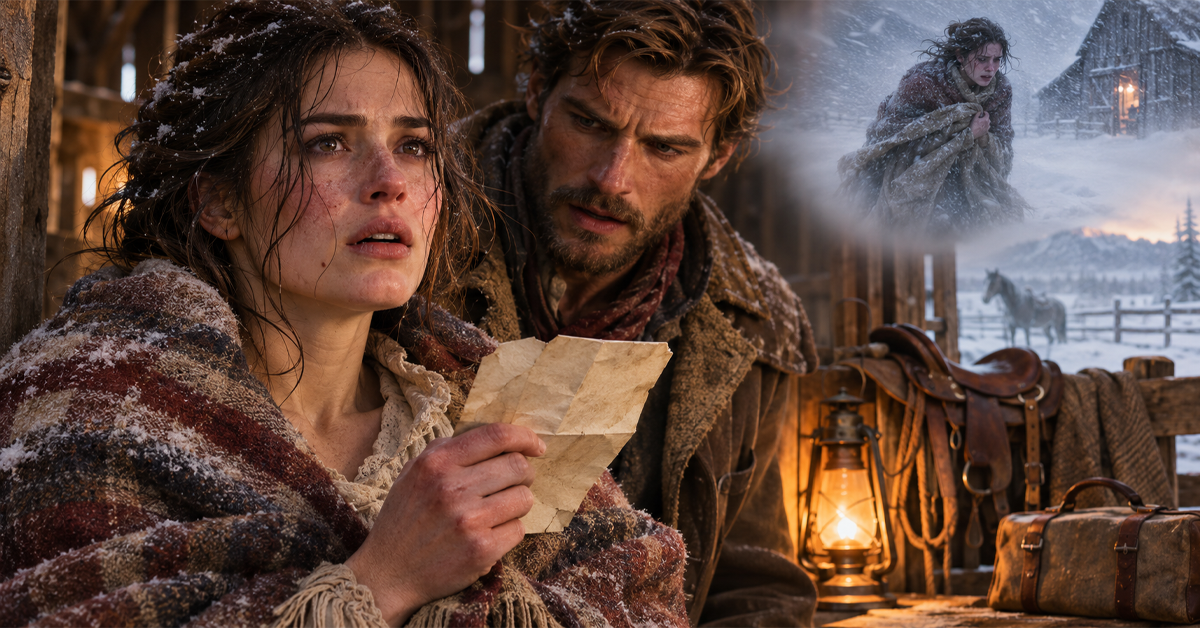
A Mail-Order Bride Was Abandoned in a Montana Blizzard and Found Shelter in a Widower’s Barn—But When Rancher Wyatt Hollis Saw the Weathered Letter Clutched in Her Frozen Hand, He Recognized His Own Handwriting and Made a Decision That Would Change Both Their Lives
Wyatt’s fingers stopped an inch from the folded letter.
For a moment, the only sounds were the wind scraping against the shutters and Rex shifting beside the hearth.
“I didn’t stop them,” Wyatt said.
Clara watched him.
“Then where is everyone?”
He could have told her it was late. He could have said she needed rest. Instead, he took the letter and sat at the kitchen table.
“They came after Margaret died. Neighbors brought food. The reverend visited. Folks offered to help with the cattle.”
“And?”
“I found reasons to turn them away.”
“Why?”
Wyatt rubbed a thumb across the softened paper.
“Because they all wanted to tell me things would get better.”
Clara said nothing.
“I knew they meant well. But every time somebody said it, I wanted to ask what better meant. The house was still empty. Margaret was still gone.”
His voice roughened.
“So eventually I stopped answering the door.”
Clara looked toward the bedroom.
“That must have been a hard way to live.”
“It was easier than talking.”
She considered that.
“Maybe easier isn’t always better.”
Wyatt looked up.
No one had spoken to him so plainly in years.
He might have resented it from someone else.
From Clara, sitting in his wife’s quilt with her hands still recovering from the cold, it sounded less like criticism than experience.
“You’re going to need rest,” he said.
She made no attempt to argue.
But when she stood, she swayed.
Wyatt rose immediately.
“May I?”
She accepted his arm.
He walked beside her to the bedroom, stopping outside the doorway.
“There’s a basin and clean water. I’ll be by the fire if you need anything.”
Clara touched the doorframe.
“Can the door close?”
“Of course.”
“And my bag?”
“I’ll bring it from the barn at first light.”
She nodded.
“Thank you.”
He returned to the kitchen, placed the letter on the table, and sat through the remaining hours of darkness.
He thought about a young woman waiting seven hours for a man who had promised her a future.
Then he thought about how readily he had abandoned his own.
By dawn, the wind had eased.
Clara emerged fully dressed, carrying herself carefully but steadily.
“I’d best be going,” she said.
“Where?”
“I haven’t decided.”
“Have you money for travel?”
She hesitated.
“A dollar and forty cents.”
Wyatt looked at the worn sleeves of her coat.
Then at the window.
Beyond it, the snow had settled around the ranch buildings. He could already see that the eastern fence line had taken damage.
His cattle would need attention before another spell of cold.
And he had nobody to help him.
“There’s work here,” he said.
Clara’s expression sharpened.
“What kind?”
“Fence repairs. Feeding cattle. Whatever needs doing until I can get the place in order.”
“I know very little about ranching.”
“I can show you.”
She remained standing.
“And what would I receive?”
“Food, the bedroom, and wages for the work.”
“How long?”
“Two weeks, to start.”
Clara approached the table.
She had spent months depending on promises made by a man she had never met.
She would not repeat that mistake without asking questions.
“The room stays mine?”
“Yes.”
“If I decide to leave?”
“I’ll take you into Miller’s Creek when the road is fit for travel.”
“And you won’t mistake employment for something else?”
Wyatt understood her meaning.
“No, ma’am.”
Clara looked at the letter lying beside his coffee cup.
There was no romance in the offer.
Only damaged fences, bitter weather, hard labor, and a rancher whose loneliness had nearly defeated him.
Yet it was the first honest opportunity she had been given since arriving in Montana.
“Two weeks,” she said. “Then we discuss whether either of us wants to continue.”
Wyatt extended his hand.
“Agreed.”
She shook it firmly.
Then, instead of returning to the bedroom, she crossed to the window.
“What is that fence supposed to protect?”
“The east pasture.”
“How many cattle?”
“Forty head on the ranch altogether.”
“And if the fence stays down?”
“We may lose part of the herd.”
Clara studied the broken line disappearing beneath the snow.
“Then I suppose we should begin soon.”
Wyatt retrieved Margaret’s old work gloves from a drawer and placed them on the table.
Clara examined the worn leather.
“Whose were these?”
“My wife’s.”
She looked at him.
“Are you certain?”
He nodded.
Clara slipped them on, flexed her fingers, and opened the kitchen door.
The cold rushed inside.
Wyatt followed her toward the yard, realizing that this stranger was about to walk into a part of his life he had kept closed for three years.
And he still had not told her that the ranch was in far greater danger than a broken fence could explain.
Clara stepped into the snow, immediately sank nearly to her knees, and caught herself against the porch rail.
Wyatt stopped beside her.
“Still feeling steady enough?”
“I’ll tell you if I’m not.”
He nodded.
That was the first thing he learned about Clara Whitmore.
She preferred an honest question to an unnecessary order.
They began with the fence nearest the barn, where the damage was easiest to reach. Wyatt showed her how to hold a replacement post, how to keep her hands clear while he worked, and how to judge whether the repaired section would withstand pressure from the cattle.
The cold forced them inside sooner than he would have liked.
Clara’s fingers remained tender from the previous night, and Wyatt refused to pretend otherwise.
But the next morning she was ready again.
By the third day, she could distinguish a sound post from one that needed replacing.
By the fourth, she knew when Wyatt was preparing to take on more work than he ought.
“You need another pair of hands for that,” she said as he struggled with a heavy section of fencing.
“I’ve managed before.”
“That isn’t what I said.”
He stared at her.
Then he surrendered the post long enough to let her help.
It was a small concession.
For Wyatt, it felt strangely significant.
He had spent three years doing every unpleasant task himself, convinced that accepting assistance meant admitting he could no longer keep Margaret’s ranch standing.
Clara had no patience for that sort of pride.
At supper, she began asking questions about his supplies.
The hay stored in the southern shed.
The cost of feed.
The number of cattle he hoped to sell in spring.
The prices he received from neighboring ranchers.
Wyatt answered some questions readily.
Others made him uncomfortable.
“Did you always take such an interest in figures?” he asked.
“My father kept a store in Missouri. I managed his accounts for several years.”
“That explains your questions.”
“Not all of them.”
She smiled faintly.
“My husband taught me a great deal, too.”
Wyatt stopped cutting his bread.
“Your husband?”
“James Whitmore.”
She set down her cup.
“He ran a dry goods business in St. Louis. I helped him with the books, the orders, and the customers.”
Wyatt waited.
“James died of typhoid fever eighteen months ago.”
“I’m sorry.”
“So am I.”
There was no bitterness in her answer.
Only a sorrow Wyatt understood.
She explained that after James died, his brother took control of the business and the home. What remained to Clara was not enough to establish herself independently.
She had returned to the little Missouri town where her father once lived.
But there was no life waiting for her there.
Her parents were dead.
Her brother had been absent for years.
And the last of her father’s possessions had already been sold to settle debts.
“So you answered Dre’s advertisement,” Wyatt said.
“I did.”
“Did you know anything about him?”
“Only what he told me.”
She looked down.
“That was my mistake.”
Wyatt shook his head.
“A man who lies in order to gain another person’s trust owns the lie.”
Clara studied him.
“You’ve thought about this.”
“I’ve heard of Dre.”
“Something unpleasant?”
“More than something.”
Wyatt told her about the man’s reputation for dubious dealings around Billings.
He did not claim to know exactly why Dre had failed to meet her.
He knew only that the promises Clara had trusted were worth considerably less than she had paid for them.
She listened without interrupting.
When he finished, she said, “Then I’ll be more careful about whose promises I accept.”
“Fair enough.”
“That includes yours.”
Wyatt almost smiled.
“It should.”
Their evenings slowly changed.
The kitchen that had once contained only the scraping of a spoon and the crackle of burning wood began to hold conversation.
Clara had opinions about the weather, the cattle, Rex’s diet, the quality of Wyatt’s coffee, and his habit of leaving tools where he could trip over them.
Wyatt discovered that he enjoyed disagreeing with her.
Not because he wished to win.
Because she argued back.
One afternoon, while he was setting another fence post, Clara asked about Margaret.
“What was she like?”
Wyatt worked for several moments before answering.
“She could make a difficult day seem manageable.”
“How?”
“Usually by telling me I was doing something foolish.”
Clara laughed.
“That sounds familiar.”
“She sang when she cooked. Couldn’t carry a tune.”
“Did you tell her?”
“Once.”
“What happened?”
“She sang louder.”
Clara laughed again.
This time Wyatt joined her.
The sound startled him.
He had forgotten how laughter could arrive before a man had time to protect himself.
On the sixth day, Bennett Crowley rode into the yard.
His expensive black horse and handsome coat looked entirely out of place beside Wyatt’s weather-beaten buildings.
Crowley remained mounted while he surveyed the ranch.
“Heard you’ve taken in a lady,” he said.
“She’s working here.”
“So the story goes.”
Wyatt did not move.
“What brings you out?”
“The same matter we’ve discussed before. Your northern land.”
“It’s not for sale.”
“You’re turning down good money.”
“It’s still not for sale.”
Crowley smiled.
“Winter has a way of changing what a man can afford to refuse.”
His eyes moved toward the house.
Then he turned his horse and departed.
Clara had watched from the porch.
“Who was that?”
“Bennett Crowley.”
“Does he own land nearby?”
“He owns more every year.”
“And he wants yours?”
“A portion of it. For now.”
She considered that answer.
“You’re in debt to him.”
Wyatt looked at her sharply.
“How did you know?”
“Men who come offering to solve your troubles usually know precisely what those troubles are.”
He looked away.
“There’s an obligation against the south pasture.”
“How serious?”
“Manageable.”
Clara’s expression told him she did not believe that word.
Three days later, she found his ledger while searching a kitchen cabinet for coffee.
The book was tucked behind flour and spare nails.
She had opened it before Wyatt entered.
He stopped in the doorway.
“That isn’t where I keep the coffee,” he said.
“No.”
Clara looked up.
“Wyatt, why have you been paying interest on the same principal for two years?”
He removed his gloves.
“I had an accident. Broke my hand and ribs. Couldn’t work for weeks.”
“And Crowley lent you money.”
“Yes.”
“At these rates?”
“He was the only one offering.”
Clara turned another page.
“You’re paying enough to keep him satisfied, but you’re not reducing what you owe.”
“I know.”
“And the hay supply is smaller than the ledger suggests you need.”
“I know that, too.”
She closed the book.
“Then we need to stop pretending this is merely a difficult winter.”
Wyatt felt anger rise.
Not toward Clara.
Toward the humiliating truth lying open between them.
“I’ve kept this place going for years.”
“And I’m trying to help you keep it.”
For a long moment neither spoke.
Then Wyatt pulled out the chair opposite hers.
Margaret’s chair.
It had stood against the wall when Clara arrived.
Now it was close enough to the table for someone to use.
He sat down.
“Show me what you see.”
Clara opened the ledger again.
Together they reviewed the cattle, feed, hay sales, expenses, and Crowley’s loan.
She noticed something Wyatt had overlooked for years.
He was selling hay well below prices he might reasonably obtain.
At the same time, he was paying Crowley without making meaningful progress on the debt.
“If the cattle survive until spring and sell at a decent price, you may still be able to clear what you owe,” she said.
“That’s what I’ve been counting on.”
“Then we need accurate accounts and enough feed to get there.”
He looked at her.
“You’ve done this kind of work before.”
“Yes.”
“Would you be willing to take charge of the books?”
“Provided I can see all of them.”
Wyatt considered her.
Then he pushed the ledger toward her.
“All of them.”
The decision changed more than his finances.
For the first time since Margaret’s death, someone else was permitted to know what frightened him.
But the valley was watching.
When they traveled twelve miles to Miller’s Creek for supplies, people stared openly.
Harold Pervvis at the general store asked too many questions.
Three women on the boardwalk stopped speaking when Clara approached.
Wyatt could see the humiliation tightening her face.
He told them plainly that Clara was employed at the ranch and deserved to be treated respectfully.
On the wagon home, she said, “You’ll only give them more to discuss.”
“Probably.”
“Then why speak?”
“Because they were speaking about you as if you weren’t standing there.”
She looked at him for a long moment.
“James used to do that.”
“Do what?”
“Remember that I could hear what people said.”
Wyatt kept his eyes on the road.
He understood what it cost her to make that comparison.
The following days brought another visitor.
Reverend Thomas Aldred appeared at the ranch to express his concern about an unmarried woman living beneath Wyatt’s roof.
Clara listened until he began discussing her reputation as though she were absent.
Then she set down the coffee pot.
“Reverend, I’m a grown woman and a widow. Mr. Hollis offered me honest employment. I accepted it.”
Aldred attempted to interrupt.
She continued.
“You may dislike the arrangement. But it is mine to explain, not yours to invent.”
Wyatt stood beside the table.
“The lady has told you the truth.”
The reverend eventually left, though not before suggesting Wyatt consider what Margaret would have thought.
Afterward, Clara sat quietly near the fire.
“Did that hurt you?” she asked.
“What he said about Margaret?”
“Yes.”
Wyatt thought carefully.
“Margaret would have taken one look at you freezing in that barn and ordered me to bring you inside.”
Clara smiled sadly.
“I think I would have liked her.”
“I believe you would.”
He looked toward Margaret’s chair.
“I think she’d have liked you, too.”
On the thirteenth evening, the damaged fence stood repaired.
The ledger lay open on the table.
And Clara was reading the old letter again.
“Did you truly believe you had nothing left to give another person?” she asked.
“When I wrote it, yes.”
“And now?”
Wyatt watched her fold the paper.
He thought about the repaired fence, their arguments over feed prices, and the sound of her footsteps crossing the kitchen every morning.
“No,” he said.
Her eyes softened.
“I didn’t remain here just because you needed help with fencing.”
Wyatt felt his heart quicken.
“I know.”
She looked surprised.
“Do you?”
“I think so.”
The fire settled in the hearth.
Neither reached across the table.
Neither wanted to turn a difficult truth into an easy declaration.
Finally, Clara said, “Our two weeks end tomorrow.”
“They do.”
She looked toward the bedroom.
“I need until morning to decide what comes next.”
Wyatt nodded.
“Take the time you need.”
She rose and carried the letter with her.
At the bedroom door, she looked back.
“If I stay, I intend to have a say in how this ranch is run.”
Wyatt almost laughed.
“I’d be surprised if you didn’t.”
“And I won’t stay because you rescued me.”
“I wouldn’t ask you to.”
Clara regarded him quietly.
“Good.”
She closed the bedroom door.
Wyatt remained at the table, staring at the empty chair opposite him.
For the first time in three years, he was no longer merely afraid of remembering the woman he had lost.
He was afraid of losing the woman who had found her way into his life.
And when dawn finally came, he heard Clara’s footsteps approaching the kitchen.
He stood as she entered.
Her coat was on.
But her traveling bag was nowhere near the door.
She looked at him and said, “Wyatt, I’ve made my decision.”
Wyatt remained standing beside the table.
Clara glanced toward the empty chair, then back at him.
“I want to stay,” she said. “Not because I have no other place to go. Not because I owe you anything. I want to stay because there’s useful work here, and because I believe we could make something good of it.”
Wyatt had imagined those words through most of the night.
Hearing them was different.
“You’re certain?”
“Certain enough to try.”
She crossed to the stove.
“But our agreement needs changing.”
He nodded.
“Tell me.”
“I’ll continue keeping the books and helping wherever I can. You’ll pay me fairly. I’ll have my own room. And when decisions affect the work I’m responsible for, I expect to be consulted.”
“Agreed.”
“That quickly?”
“I’ve learned you don’t ask for things without thinking them through.”
Clara smiled.
“Then we understand each other.”
Wyatt poured her coffee.
Outside, the ranch lay pale beneath the winter sky.
For a few minutes, everything seemed possible.
Then winter reminded them that possibilities did not pay debts.
Four days later, Wyatt’s usual feed merchant refused to extend further credit.
Roy Haskell had supplied the ranch for years.
He had never before questioned Wyatt’s reliability.
Now an order had been turned away, and the message delivered with considerable embarrassment.
Clara examined the ledger that evening.
“Crowley,” she said.
Wyatt nodded.
“Most likely.”
“He wants you desperate enough to sell before spring.”
“He’s getting closer.”
Clara looked at the hay calculations.
“Then we speak to Haskell ourselves.”
“He knows me.”
“Yes. And somebody has made him doubt what he knows.”
She took out a clean sheet of paper.
“We’ll show him the payments.”
The next morning, they drove to Miller’s Creek.
Haskell looked uneasy when Wyatt entered.
But it was Clara who placed the ledger on the counter.
“Mr. Haskell, before you decide whether to refuse another order, I’d like you to see something.”
She showed him the recorded payments to Crowley.
Every installment had been made.
Whatever pressure the debt created, Wyatt was not in arrears.
Haskell read the figures twice.
“Crowley told me the account had gone bad.”
“Then he gave you incorrect information,” Clara said.
Haskell looked at Wyatt.
“Have you missed a payment?”
“No.”
The merchant lowered his eyes.
“I should have asked you.”
“Yes,” Wyatt replied.
Clara did not press for an apology.
She asked him to consider an order based on Wyatt’s years as a paying customer.
Haskell agreed to restore the account.
Outside, Wyatt helped her down from the boardwalk.
“You handled that well,” he said.
“I know.”
He laughed.
Clara looked pleased.
It was the kind of laugh that had become increasingly common around her.
But Bennett Crowley had not exhausted his patience.
Two days later, he returned with a lawyer named Gerald Tate.
They arrived while Wyatt was splitting wood.
Clara came onto the porch as Crowley announced that he intended to settle the matter of the south pasture.
Tate produced a document.
“The terms are plain,” Crowley said. “The land becomes mine if the debt isn’t cleared by the first of March.”
Wyatt frowned.
“That isn’t what my agreement says.”
“Then perhaps you haven’t read it carefully.”
Clara stepped down from the porch.
“May I see the document?”
Tate handed it to her.
She read without speaking.
Then she went back to the first page.
“What is this supposed to be?”
“A copy of the agreement,” Tate answered.
“It doesn’t match the agreement Mr. Hollis showed me.”
Crowley’s smile thinned.
“Perhaps you’re mistaken.”
“The original provides a longer payment period and an opportunity to request an extension. This paper removes both.”
She turned toward Tate.
“Where did you obtain it?”
The lawyer hesitated.
Crowley answered instead.
“Miss Whitmore, ranch business is complicated.”
“Then we should be especially careful with the documents.”
Wyatt stepped beside her.
“I have my signed copy inside.”
“And I would like to compare it with whatever was filed in the county records,” Clara said.
Tate looked between them.
There was no immediate confession.
No dramatic surrender.
But Crowley’s insistence that the matter was simple had suddenly become much harder to maintain.
He left with his lawyer, warning Wyatt that debts did not disappear merely because someone disliked the terms.
After the riders departed, Wyatt and Clara stood in the yard.
He looked at the paper she had retained for comparison.
“Did you truly see all that so quickly?”
“I’ve spent years reading agreements written by men who expect nobody to question them.”
“Then I’m fortunate you were here.”
Clara looked at him.
“Fortunate?”
“Yes.”
“I thought I was the unfortunate one when I reached your barn.”
Wyatt considered that.
“Perhaps we were both mistaken.”
They went inside and began assembling the records.
The next weeks brought a succession of hard journeys and difficult conversations.
They obtained information about the recorded agreement.
They sought advice about the disputed terms.
They learned of other ranchers who had lost land after dealing with Crowley.
The problem was larger than Wyatt’s debt, though establishing exactly what had happened required more than suspicion.
Clara understood that better than anyone.
She kept dates, copies, amounts, and names in careful order.
Wyatt began meeting people he had avoided for years.
He spoke to neighboring ranchers.
He returned to town more often.
He allowed others to see that he was struggling.
That, for him, was nearly as difficult as admitting how much he cared about Clara.
One afternoon, she found him standing near the barn, looking toward Margaret’s grave.
“Do you want to be alone?” she asked.
“No.”
She stood beside him.
After a while, Wyatt said, “For three years, I thought the decent thing was to keep everything exactly as Margaret left it.”
Clara waited.
“I wouldn’t move her chair. Wouldn’t use her sewing basket. Wouldn’t ask for help because I thought keeping the ranch going alone was somehow proof I hadn’t forgotten her.”
“And now?”
“Now I’m beginning to think I’ve mistaken remembering for refusing to live.”
Clara looked at the cross beyond the house.
“James and I were happy,” she said. “When he died, I thought being happy again would mean what we had wasn’t enough.”
Wyatt turned toward her.
“Do you still think that?”
“No.”
She looked at him.
“But I am afraid.”
“So am I.”
He reached toward her, stopping before their hands touched.
Clara took his hand.
That simple answer gave him the courage to speak.
“I care for you, Clara. More than I meant to.”
“I know.”
“I don’t want to rush you.”
“Then don’t.”
He smiled faintly.
She stepped closer.
“And don’t mistake going slowly for standing still.”
This time, when he bent toward her, she met him halfway.
Their first kiss was gentle, brief, and entirely their own choice.
Nothing about Crowley’s debt improved because of it.
Nothing about the winter became easier.
But the two people facing those troubles no longer had to pretend they felt nothing.
The next major development came when a newspaper account exposed questions surrounding Crowley’s property dealings.
The report described the disputed documents and the experiences of other ranchers.
It did not settle their claims.
But it brought information into the open that Crowley had preferred to keep private.
Further legal action followed.
Wyatt and Clara understood that any final decision could take months.
Meanwhile, they had cattle to feed and a ranch to maintain.
The winter dragged on.
Snow lay in the shaded places long after the main roads opened.
The herd needed constant attention.
Clara continued managing the accounts, and Wyatt began consulting her before making purchases or agreeing to sales.
They disagreed.
Frequently.
He sometimes wanted to help neighbors at prices the ranch could not afford.
She occasionally calculated a figure without allowing enough room for an unexpected expense.
Neither was always right.
And neither expected the other to remain silent.
That was how their partnership became real.
Not through perfect agreement, but through the daily practice of listening.
Then Crowley found another way to frighten them.
A letter arrived from a law firm in St. Louis concerning an old creditor’s claim against the estate of Clara’s late husband.
It questioned whether money associated with that estate might be recoverable.
The amount that concerned Clara most was eleven dollars.
Money she had earned and offered to lend toward the ranch’s feed purchases.
Wyatt found her sitting at the table with the letter spread before her.
“What’s happened?”
She handed it to him.
He read carefully.
“Has anyone determined that you owe this?”
“Not yet.”
“Then it’s a claim, not a judgment.”
Clara nodded.
But her face remained pale.
“That’s not what frightens me.”
“What does?”
“Somebody knew where to find me. Somebody knew enough about James’s affairs to reach into my old life.”
She swallowed.
“And I think Crowley wants the whole valley to believe I’m bringing trouble to your ranch.”
Wyatt placed the letter beside the ledger.
“Would they believe him?”
“Some would.”
“Perhaps.”
“Perhaps?”
He sat opposite her.
“I can’t make everyone think well of you. I learned that during the first week you were here.”
She tried to smile.
“But I can tell the truth when I’m asked. And I can refuse to let Crowley choose whom I trust.”
Clara looked at the legal letter.
“I don’t want to become another burden.”
Wyatt shook his head.
“You’re not a debt in this book.”
He touched the ledger.
“And I won’t let anyone treat you as one.”
She covered her face briefly.
Then she lowered her hands.
“I need to know that if this becomes too much, you won’t feel obliged to keep protecting me because you found me in the barn.”
Wyatt answered without hesitation.
“You may leave whenever you decide to. But please don’t leave because you imagine I’ve already made the decision for you.”
Clara remained still.
Then she pushed the letter aside and reopened the accounts.
“All right,” she said. “Let’s see what can be proved.”
They answered the claim through the proper channels and continued gathering records.
The pressure did not disappear.
But it no longer controlled every decision they made.
As winter loosened its hold, more information about Crowley’s dealings emerged.
Other ranchers challenged the agreements that had cost them property.
The county records became important evidence.
So did the altered document Clara had questioned in Wyatt’s yard.
By the middle of February, the newspaper coverage had made Crowley’s conduct a public matter.
By spring, the disputes were moving through the legal process.
Wyatt sold cattle when market conditions allowed, using the proceeds to strengthen the ranch’s position and meet its legitimate obligations.
Clara checked every payment.
He checked every fence.
Some evenings they were too tired to speak.
Others found them arguing over whether the north gate could survive another month without repair.
“It leans,” Clara told him.
“It still opens.”
“That isn’t the same thing as working.”
“I’ll fix it.”
“You’ve been saying that for weeks.”
Wyatt laughed.
“One day you’ll run out of things to correct.”
“I doubt it.”
When the weather permitted, he finally repaired the gate.
Clara inspected the work with exaggerated seriousness.
“Acceptable.”
“High praise.”
“Don’t grow accustomed to it.”
He took her hand.
She squeezed his.
By May, the news they had fought toward finally arrived.
The disputed lien against Wyatt’s land had been formally voided.
The south pasture was secure.
The ranch could continue without Crowley’s claim hanging over its future.
Wyatt brought the message home from Miller’s Creek and placed it in front of Clara.
She read it once.
Then again.
She looked up.
“We’ve done it?”
“We have.”
She stared at the table.
For months, she had held herself together with work, figures, and careful planning.
Now her eyes filled.
Wyatt pulled out the chair beside her.
“You can be relieved,” he said.
“I am.”
She laughed unsteadily.
“I’m terribly relieved.”
He reached for her hand.
She gave it to him.
For a while, they sat together without saying anything else.
Neither had forgotten how close they came to losing the ranch.
Neither mistook the outcome for proof that every hardship could be defeated through determination.
But this time, their work had mattered.
Their choices had mattered.
And the land beyond the windows would remain a place where they could build a future.
In June, a second letter arrived.
This one came from Gerald Tate.
The lawyer had cooperated with the investigation into Crowley’s transactions and supplied information about several other properties.
His account made clear that the discrepancy Clara caught in the document was central to uncovering the wider pattern.
Wyatt read the letter at the post office.
Then he drove home.
Clara was at the kitchen table, checking a hay account.
He placed Tate’s letter beside her.
“Read this.”
She did.
When she finished, her expression changed.
“Six ranches?”
“That’s what he documented.”
She looked at the page again.
“Because of that paper?”
“Because you noticed what somebody hoped wouldn’t be noticed.”
Clara shook her head.
“I was only doing what I knew how to do.”
“Yes.”
He pulled out the chair opposite her.
“And it mattered.”
She stared at him.
All her life, people had decided what she was worth according to what she possessed, whom she married, or what family name she carried.
When James died, she had lost nearly everything that gave her security.
When Callum Dre abandoned her, she had believed she was making the last foolish mistake of a woman who had run out of chances.
Now Wyatt was telling her that the skill she carried in her own mind had helped protect more families than she had ever expected.
Clara stood.
She crossed the kitchen and put her arms around him.
He held her close.
After a long moment, she said into his coat, “I keep thinking something will happen and all this will be taken away.”
Wyatt rested his cheek against her hair.
“I know.”
“I’ve lost people I meant to grow old beside.”
“So have I.”
She lifted her face.
“And I’m frightened of how much I want this.”
He looked into her eyes.
“Then we’re frightened of the same thing.”
She smiled through her tears.
“That’s inconvenient.”
“Very.”
He kissed her forehead.
Then he said, “Clara, there’s something I want to ask.”
She stepped back far enough to study him.
“That sounds serious.”
“It is.”
“Then ask plainly.”
Wyatt drew a breath.
“I want us to marry.”
Her expression softened, but she did not answer immediately.
He continued.
“Not because you’re living here. Not because of the town. Not because of anything you owe me.”
He glanced toward the ledger.
“I want you to remain my partner in this work. I want you to have a proper say in what we build. And I want to grow old having to explain why the north gate is still crooked.”
Clara laughed.
“It’s straight now.”
“Then you’ll find something else.”
“I most certainly will.”
He took both her hands.
“Would you marry me?”
She looked toward the window.
Beyond it lay the land she had helped preserve.
The barn where she had nearly frozen.
The fence she had learned to mend.
The road that could still take her away if she chose to go.
She had money she had earned, work she understood, and plans she wanted to pursue.
She was not the desperate woman who had waited at a crossroads for someone else to decide her life.
She turned back to him.
“Yes, Wyatt.”
His shoulders eased.
“Yes?”
“Yes. But I intend to remain involved in the accounts.”
“I wouldn’t dare stop you.”
“And I’d like us to discuss improvements to the east pasture.”
“I had a suspicion.”
“And if we’re marrying, I expect you to speak to me when something is wrong instead of hiding it behind a sack of flour.”
Wyatt laughed.
“Agreed.”
Clara smiled.
“Then yes. Entirely yes.”
They were married on a Saturday in late June at the little church in Miller’s Creek.
Reverend Aldred officiated.
His wife, Martha, helped Clara alter a blue wool dress for the occasion.
Roy Haskell attended.
So did several neighboring ranchers.
Harold Pervvis stood toward the back of the church, looking considerably less judgmental than he had during Clara’s first visit to his store.
Clara walked down the aisle alone.
No one handed her from one man’s care into another’s.
She came forward because she had chosen to.
Wyatt stood waiting in his good coat.
When their eyes met, his expression held a warmth that would have astonished anyone who remembered him during the years after Margaret died.
Their vows were simple.
He promised faithfulness, honesty, and a home in which her judgment would be valued.
She promised the same honesty and loyalty, along with the determination that had carried them through the winter.
When the ceremony ended, they emerged into the June sunlight together.
For once, Wyatt did not mind the crowd.
He knew most of the people standing there.
Some had judged them harshly.
Some had helped.
Some had changed their minds only after the evidence became impossible to ignore.
That was the way of an imperfect community.
Clara accepted their congratulations without pretending the winter had been forgotten.
Then she took Wyatt’s arm and walked toward their wagon.
Their journey home took them past the old crossroads.
The post still stood beside the road.
A weathered piece of timber, ordinary enough to escape anyone’s attention.
Clara asked Wyatt to stop.
They climbed down.
For a moment, she studied the place where she had waited for Callum Dre.
“I thought my life had ended here,” she said.
Wyatt stood beside her.
“Mine had been standing still for three years before that.”
She looked at him.
“Do you ever wonder how your letter reached this place?”
“Sometimes.”
“You still don’t remember?”
“Not clearly.”
He shook his head.
“I know what I wrote. I know I thought I’d destroyed it. The rest may never be certain.”
Clara considered the old post.
Then she smiled.
“Perhaps we don’t need every answer.”
Wyatt took her hand.
“No. Perhaps not.”
They drove home to a ranch that looked much as it had before.
The barn roof still needed attention.
There were still accounts to settle and cattle to tend.
Rex was older and preferred the warmth near the hearth to any grand adventure.
The winters would remain difficult.
The work would never be finished.
But there were two chairs at the kitchen table now.
Two cups beside the stove.
A ledger Clara kept with unwavering care.
And a rancher who no longer considered silence the only respectable way to carry grief.
The old letter rested in a small cedar box in the room Clara had made her own.
She had not asked him to destroy it.
He had not asked her to forget the husband she had loved.
Their previous lives remained part of them.
But neither past would be allowed to dictate every day that followed.
One evening, after the cattle were settled and the last light had gone behind the hills, Clara found Wyatt standing on the porch.
“What are you thinking about?” she asked.
He glanced toward the barn.
“The night you arrived.”
“I wasn’t a very impressive sight.”
“You were holding on to that letter as though it mattered more than anything.”
“It did matter.”
“Why?”
Clara considered her answer.
“Because I had been promised a home by someone who never intended to give me one. And then I found a letter from someone who had loved his home so much that losing the person who shared it had nearly destroyed him.”
Wyatt looked at her.
“I thought perhaps a man who could write something like that might understand why I was frightened.”
“Was I what you expected?”
“Not remotely.”
He laughed.
She slipped her hand into his.
“Good.”
They stood together while the evening settled over Black Pine Creek.
Once, Wyatt had believed that the measure of his devotion to Margaret was how completely he could preserve the life they had shared.
Now he understood that love did not demand an empty house.
And Clara, who had crossed half the country searching for a place where she might be wanted, had discovered something more important than being chosen.
She had found a place where her work mattered, her word carried weight, and her future remained her own to decide.
The barn where Wyatt first found her remained standing.
So did the little house.
But neither meant what it had meant that winter.
The barn was no longer merely the place where a desperate traveler sought shelter.
The house was no longer the place where a widower hid from the world.
They had become the beginning and the center of a life two people were building deliberately, day after day.
Clara rested her head against Wyatt’s shoulder.
“There’s still something we need to discuss,” she said.
He sighed with theatrical resignation.
“The east pasture?”
“The east pasture.”
“Tomorrow?”
“After breakfast.”
He put his arm around her.
“All right.”
Inside, Rex barked once, impatient for company.
Clara laughed and opened the door.
Wyatt followed her into the warm kitchen.
And this time, when the door closed against the Montana night, it did not shut the world out.
It closed around a home that had learned how to welcome life again.
If you’re still here, thank you. That means more than you know.
Hit subscribe if you want to hear more stories like this one.
Until next time, take care of yourself.
THE END!
Disclaimer: Our stories are inspired by real-life events but are carefully rewritten for entertainment. Any resemblance to actual people or situations is purely coincidental.