PART 2: A FORGOTTEN MAIL-ORDER BRIDE HELPED A WOUNDED COWBOY, NEVER KNOWING HE OWNED THE LARGEST RANCH.
PART 1: THE STRANGER BENEATH THE STONES
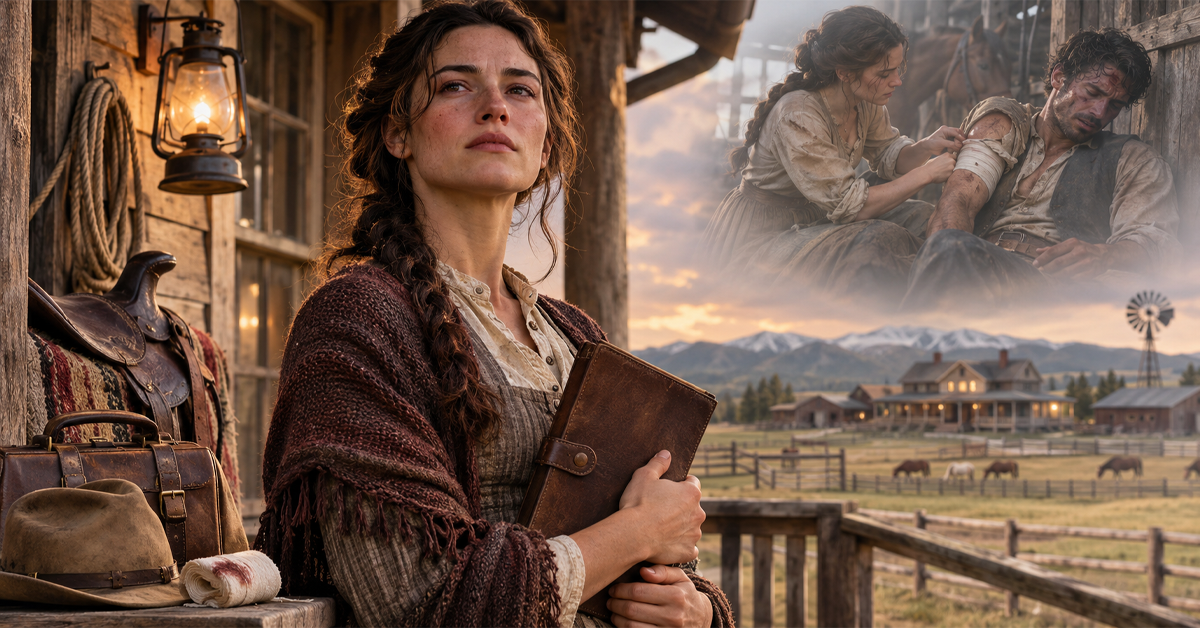
The first man I found in Wyoming was bleeding to death beneath a fallen mountain, and the man who had promised to marry me was nowhere to be found.
I stood in the narrow canyon with my mother’s brass watch in my pocket, a stranger’s blood staining the dust, and the terrible understanding that I might be the only person who could save him.
Five pale fingers reached from beneath a slab of granite, one bearing a worn silver ring that caught the last light of the afternoon.
For one dreadful moment, I believed I had found a dead man.
Then I saw his chest move.
I dropped my valise beside a patch of sagebrush and scrambled toward him, scraping my knees against rocks still warm from the day’s relentless sun.
His dark hair was thick with blood, his shirt torn across one shoulder, and his left leg trapped beneath a stone nearly as wide as my mother’s kitchen table.
I had been abandoned at a railway station that morning, and I had spent the following hours wondering whether any man in this country could be trusted.
Now a complete stranger lay helpless before me, and somehow his survival had become my responsibility.
“Can you hear me?”
I asked, kneeling close enough to see the dust trembling against his lips.
His breathing answered me, although nothing else did.
Twenty paces behind us stood a chestnut horse with dried foam along its neck and blood smeared across the saddle, watching me with frightened brown eyes.
I knew almost nothing about horses, but even I understood that the animal had been running for its life.
The canyon wall above us showed a fresh wound where pale stone had broken loose, leaving jagged edges against the darker rock.
I looked at the fallen stones, the unconscious man, and the ribbon of daylight remaining above the canyon.
Every sensible thought told me to take his horse and ride for help.
Unfortunately, I had never been particularly talented at obeying sensible thoughts when someone needed me.
My name was Amelia Hart, and until three days earlier, I had never traveled farther west than Kansas City.
I was twenty-two years old, unmarried, nearly penniless, and carrying everything I owned in a battered leather valise that had once belonged to my mother.
I had come to Wyoming because a stranger named Mercer had written me a letter asking whether I might consider becoming his wife.
Forty-seven words had persuaded me to surrender the only life I knew.
He described himself as honest, hardworking, and possessed of few graces, with a sturdy home and a desire for companionship in difficult country.
He promised there was beauty in the land if a person knew where to look.
Most importantly, he promised to meet me at Fork Ridge station on June fourteenth.
I had arrived that morning wearing my best blue dress, carrying a small bouquet of dried lavender, and believing that even a marriage arranged through letters might begin with kindness.
But noon had passed, then one o’clock, then two, and no man had come asking for Amelia Hart.
The stationmaster, Mr.
Baines, had examined my letter and scratched the gray whiskers beneath his chin.
“Mercer is a mighty important name around here,” he had told me, glancing toward the distant hills.
He said the Mercer spread was the largest ranch between Fork Ridge and the territorial line, although he had seen nobody from the property in nearly a week.
I had imagined a prosperous ranch with a dozen hired men and perhaps a house large enough to lose myself inside.
That possibility frightened me almost as much as being abandoned.
A poor girl could sometimes survive a poor man’s disappointment, but I feared a wealthy man’s contempt might destroy what little dignity she had left.
Still, I had waited until the shadows stretched across the platform before deciding I would not spend another night sitting among strangers.
Mr.
Baines had warned me that the ranch country lay beyond the western hills and that the road became difficult after the creek crossing.
I had thanked him, tightened my bonnet, and started walking.
Two hours later, a riderless horse had come stumbling around a bend, and the blood on its saddle had led me into the canyon.
Now the stranger beneath the rocks was making a faint, terrible sound.
I crawled toward his trapped leg and began pulling away smaller stones with both hands.
The first came loose easily, but the next tore a strip of skin from my thumb.
I wrapped the injured hand in my handkerchief and kept working.
The stones smelled of hot dust, and each movement sent little avalanches of gravel sliding against my boots.
I uncovered his shoulder, then part of his coat, before reaching the enormous slab pinning his leg.
“Please don’t die,” I whispered, as though he had any control over the matter.
I braced my shoulder against the stone and pushed until my arms trembled.
Nothing happened.
I changed my footing, dug my heels into the dirt, and tried again.
The stone shifted barely an inch before settling back into place.
My breath came in desperate bursts, and the heat pressed against me until my vision blurred.
I remembered my mother lifting heavy laundry baskets while coughing blood into a handkerchief and refusing to admit she needed help.
She had worked until the morning she could no longer rise from bed.
I had inherited her stubbornness, although I hoped to use it more wisely.
Finding a narrow piece of fallen timber among the stones, I forced one end beneath the slab and wedged a smaller rock underneath.
The makeshift lever groaned when I leaned against it.
The slab lifted just enough for the stranger’s trapped boot to shift.
He cried out without opening his eyes.
“I’m sorry,” I gasped, tears springing unexpectedly into my eyes.
I pressed harder.
The timber cracked, the enormous rock scraped sideways, and suddenly his leg slid free.
I fell backward against the gravel, too exhausted to celebrate.
For several moments, I could only sit there listening to his breathing while the last sunlight touched the rim of the canyon.
Then his eyes opened.
They were pale gray, like the winter sky over St.
Louis when snow threatened but had not yet fallen.
He looked at me without understanding, and I saw the effort it took him simply to remain conscious.
“Easy,” I murmured, pushing his damp hair away from the wound on his forehead.
His lips moved.
I bent closer.
“Water,” he whispered.
I remembered the canteen hanging from the chestnut’s saddle and hurried back across the rocks to retrieve it.
The horse stepped away when I approached, but I spoke softly until it allowed me to touch its neck.
“There now, sweetheart,” I whispered, uncertain whether I was comforting the animal or myself.
I returned with the canteen, supported the stranger’s head, and let a little water reach his mouth.
He swallowed painfully before coughing against my sleeve.
“Not too quickly,” I told him.
His gaze wandered across my face before settling briefly on the blood covering my fingers.
“Who are you?” he asked.
“Someone with exceptionally poor timing,” I replied.
His mouth moved as though he might smile, but the expression vanished beneath a grimace.
I examined his leg, discovering terrible swelling around the ankle but no obvious broken bone piercing the skin.
The wound on his forehead frightened me more because he seemed unable to keep his eyes focused.
“We need shelter,” I said.
He caught my wrist with surprising strength.
“Cabin,” he breathed.
“Where?”
“Creek… half a mile.”
He turned his head toward the narrow stream winding through the bottom of the canyon.
“Follow it.”
His fingers loosened, and his eyes rolled closed.
I shook his shoulder gently.
“Sir?”
He did not respond.
“Sir, you must stay with me.”
Nothing.
The canyon was becoming dark, and a cold breeze had begun to replace the afternoon heat.
I considered leaving him while I fetched help, but there was no guarantee I could find the town again before morning.
Even if I succeeded, I feared he would be dead before anyone reached him.
I knelt beside the stranger and examined the distance between his body and the waiting horse.
He was broad-shouldered and tall, with the solid weight of a man accustomed to working outdoors.
I was barely five feet four inches, and my arms already ached from moving the rocks.
Nevertheless, I gathered his coat beneath his shoulders and pulled.
He moved perhaps six inches.
I tried again, dragging him over loose dirt until the rocks began catching beneath his boots.
Each movement made him groan, and I apologized so often that eventually the words lost their meaning.
By the time I reached the chestnut, sweat had soaked through the collar of my dress.
The horse snorted and tossed its head when I attempted to guide it closer.
“Please,” I told the animal, resting my forehead briefly against its warm neck.
“I have already been stood up by one gentleman today, and I cannot manage another disappointment.”
The horse lowered its head, which I chose to interpret as cooperation.
I studied the saddle, the ropes secured behind it, and the long coat wrapped around the stranger’s body.
My father had been a carpenter before illness carried him away, and he had taught me that strength mattered less than understanding where to place it.
I found two sturdy branches caught among the fallen rocks and lashed them together with the spare rope.
After spreading my wool shawl between the branches, I fashioned a crude dragging frame, narrow enough to pass along the creek.
Getting the stranger onto it required every remaining ounce of strength.
I rolled him carefully onto his uninjured side, slid the frame beneath him, and pulled his body back until his shoulders rested against the shawl.
He groaned when I touched his leg.
I stopped long enough to whisper another apology.
Then I tied the front of the frame to the saddle using the rope, praying the branches would hold.
The horse resisted my first gentle tug, but it eventually began walking when I took the reins and spoke to it.
The frame scraped over the ground behind us.
I kept one hand on the reins and the other near the injured man’s shoulder, watching for stones that might overturn the makeshift litter.
The creek twisted through the canyon like a dark ribbon, its banks dotted with pale grass and scrubby cottonwoods.
As we followed it, the air grew colder, and the first stars appeared overhead.
I could no longer see the path clearly, so I learned to recognize the firmer ground beneath my boots.
Every few minutes, I stopped to check the stranger’s breathing.
Sometimes he murmured words I could not understand.
Once he reached upward as though trying to catch something, and I held his hand until the movement stopped.
The silver ring felt unexpectedly smooth against my palm.
A married man, I thought, watching its dull surface catch a fragment of starlight.
Perhaps a wife was waiting somewhere, wondering why her husband had not come home.
Perhaps children would be sitting beside a supper table, listening for familiar footsteps.
I felt a strange ache at the thought of people waiting for him.
Nobody had been waiting for me at Fork Ridge.
Nobody would know where to search if I disappeared into these hills.
The realization frightened me enough that I almost stopped walking.
But then the stranger coughed, and I remembered that loneliness was not the worst thing the night could bring.
We continued along the creek.
At one sharp bend, the dragging frame struck a buried stone and overturned.
The man’s injured leg twisted beneath him, and his cry echoed between the canyon walls.
I dropped the reins immediately.
“I’m here,” I said, struggling to right the frame.
The chestnut stamped nervously while I knelt beside its rider.
His eyes opened briefly.
“Leave me,” he whispered.
The words struck harder than I expected.
I thought of my mother asking me to go outside for fresh air during her final days because she could not bear to let me watch her suffer.
I thought of the quiet room afterward and the unbearable knowledge that leaving had changed nothing.
“No,” I said firmly.
He seemed to gather enough strength to look at me.
“You’ll… get hurt.”
I wiped my bleeding palm against my skirt.
“I am already hurt, sir, and I would appreciate it if you stopped offering advice.”
For one remarkable instant, he almost laughed.
Then his eyes closed again.
I straightened the frame, tightened the rope, and guided the horse forward.
The path climbed away from the creek before descending into a shallow hollow surrounded by cottonwoods.
There, beneath a crooked ridge of stone, stood a small log cabin.
A narrow porch faced the water, and a woodpile rested beneath one window.
Relief struck so violently that my knees weakened.
“Thank heaven,” I whispered.
The cabin door was unlocked.
Inside stood a narrow bed, a rough wooden table, a cast-iron stove, two chairs, and shelves lined with jars and folded blankets.
The room smelled of old smoke, leather, and the dry cedar that had been stacked beside the hearth.
There was no sign of anyone living there permanently, but the place was orderly and stocked for emergencies.
I found matches above the stove and lit a lamp.
Its amber light revealed a clean blanket on the bed and a large wooden chest beneath the window.
I returned to the stranger and untied the dragging frame.
Getting him across the threshold took nearly half an hour.
I used the porch step to lift one side of the frame, dragged him inside, and slowly worked his body toward the bed.
When he finally lay upon the mattress, I leaned against the wall and cried.
I cried for my ruined dress, my aching hands, the terrible journey, and the man who had promised to meet me but had not come.
I cried because the stranger still breathed and because I had been afraid he would not.
Then I wiped my face with my sleeve and began searching the cabin for supplies.
A kettle stood beside the stove, and a covered bucket held enough clean water to wash his wounds.
Inside the wooden chest, I found linen strips, a bottle of spirits, soap, and a small tin containing needles and thread.
Someone had prepared the cabin for the possibility of accidents.
That thought gave me comfort because it meant the stranger might know people capable of helping him.
I built a small fire and warmed water while the horse waited outside.
The stranger’s forehead wound was ugly but less deep than I had first feared.
I cleaned the dried blood from his face, washed the cut carefully, and tied a linen bandage around his head.
He flinched when the cloth touched his skin but did not wake.
His ankle was already swollen badly, and I feared moving it without knowing whether bones were broken.
I wrapped it lightly, supported the leg on folded blankets, and avoided forcing it straight.
My mother had taught me how to care for fever, cuts, and weakness, but she had never expected me to become a doctor in the Wyoming wilderness.
I tried to remember everything she had said during the months when I had cared for her.
Keep the patient warm, offer water when he can swallow safely, and never mistake silence for comfort.
Above all, pay attention.
I moved the lamp closer and watched the stranger’s chest.
His breathing remained shallow but regular.
I checked my mother’s watch.
Nine minutes after ten.
I had been in Wyoming less than a day, and I was already spending the night alone with an unconscious man.
There was a time when such a situation would have ruined a woman’s reputation beyond repair.
At that moment, I could not imagine caring less.
I found a chipped cup in the cupboard, washed it, and filled it with fresh water from the bucket.
Then I removed my bonnet and placed it beside the bed.
My hair had escaped its pins, and there was dirt beneath my fingernails that I suspected would remain for weeks.
I looked nothing like the hopeful young bride who had stepped from the train.
Perhaps that girl had vanished somewhere between the empty platform and the fallen rocks.
I hoped the woman taking her place would have enough courage for whatever came next.
A gust rattled the window.
The stranger shifted beneath the blanket.
I crossed the room immediately and pressed the back of my hand gently against his cheek.
His skin felt warmer than before.
“Can you hear me?”
I asked.
His eyelids fluttered.
I leaned closer, hoping he might tell me his name or explain where I could find help.
Instead, he caught my sleeve.
His grip was weak but urgent.
“Don’t,” he whispered.
“Don’t what?”
His lips trembled.
“Don’t… go.”
Something in his voice brought tears to my eyes.
Perhaps he was dreaming of someone who had already left him.
Perhaps he understood enough to know that I was the only person nearby.
I sat on the edge of the bed and held his hand.
“I’m not going anywhere tonight,” I promised.
He relaxed slightly, although his breathing continued to trouble me.
I thought about my own promise to marry a stranger and wondered whether he had waited at the station after I left.
Perhaps there had been some misunderstanding.
Perhaps the man called Mercer had changed his mind and lacked the decency to say so.
I opened my valise, removed his letter, and smoothed its worn folds against my knee.
The familiar words looked different beneath the cabin lamp.
I had once imagined a kind face behind them, a lonely man standing beside a fence and searching the road for someone who might choose him.
Now I could only see an empty railway platform.
I folded the letter again and slipped it beneath my mother’s journal.
There would be time to mourn my foolish hopes after the stranger survived.
Outside, the chestnut suddenly whinnied.
I rose and went to the door, wondering whether someone had followed our tracks.
The creek glittered beneath the stars, and the dark cottonwoods stood motionless along the bank.
Nothing moved beyond the porch.
I brought the horse closer, tied it where it could reach the grass, and returned to the cabin.
The stranger’s breathing had grown faster.
I hurried to his bedside and saw that his face had become strangely pale beneath the bandage.
I touched his wrist, searching for a pulse as my mother had taught me.
It was there, but weak.
“Stay with me,” I whispered.
I drew the blanket higher and watched him struggle through another breath.
His chest rose.
Then it fell.
I counted the seconds while the fire cracked softly behind me.
One.
Two.
Three.
The terrible stillness stretched.
I leaned forward, waiting for the next movement.
Nothing came.
I put my ear near his mouth, desperate to hear even the faintest breath.
The man I had dragged half a mile through the darkness was no longer breathing.
PART 2: THE NAME HE SPOKE IN THE DARK
I pressed my trembling fingers against the stranger’s neck, praying that the faint movement beneath his skin was truly a pulse.
His chest remained still, and I felt the old terror of my mother’s final morning returning with such force that the cabin seemed to tilt around me.
“No,” I whispered, gripping his shoulders.
I lowered him flat, tilted his head enough to open his airway, and checked that nothing blocked his mouth.
My mother had taught me the basics of helping someone who had stopped breathing, although I had never imagined using that knowledge on a grown man.
I gave him careful rescue breaths, watching desperately for his chest to rise.
When he remained unresponsive, I began pressing firmly against the center of his chest, counting beneath my breath.
The effort made my injured hands ache, but fear left no room for hesitation.
I stopped briefly to give him more breaths and continued until my arms trembled.
Then he coughed.
The sound was rough and violent, but it was the sweetest sound I had heard since leaving St.
Louis.
His chest rose sharply as he dragged air into his lungs.
I turned his head slightly and kept him steady while he struggled through another breath.
“There you are,” I whispered, tears falling onto the blanket.
“There you are.”
He did not open his eyes.
But he breathed.
I remained beside him for a long time, measuring every rise of his chest against the ticking of my mother’s watch.
When his breathing settled, I checked the bandage around his head and made sure his injured leg remained supported.
The cabin had grown colder, so I added another piece of cedar to the stove.
I wanted to run outside and scream for help, but there was nobody to hear except the horse.
Instead, I sat beside the bed and listened.
The wind touched the roof.
The creek murmured beneath the trees.
The watch ticked in my lap.
Near midnight, the stranger began to shiver.
I warmed another blanket beside the stove and covered him without disturbing his leg.
He muttered something that sounded like a name.
I bent closer, but the words dissolved into a feverish mumble.
His forehead felt warm, though I could not tell how much was fever and how much came from the heated room.
I washed his face again and offered a little water when he became awake enough to swallow.
His eyes opened briefly.
“You’re still here,” he rasped.
“Unfortunately for both of us, I seem to have taken charge.”
His gaze moved toward the ceiling.
“Cabin?”
“Yes, and I believe you owe whoever built it a considerable debt of gratitude.”
He tried to lift his head.
I stopped him with a gentle hand against his shoulder.
“Please stay still.”
“Leg?”
“Badly hurt, but still attached, which I consider encouraging.”
He looked toward his ankle and grimaced.
“I can’t remember.”
“You were caught beneath a rockslide.”
Recognition flickered across his face, followed by alarm.
“My horse.”
“Outside, eating grass and behaving better than either of us.”
His eyes closed again.
“Good.”
I hesitated before asking the question that had troubled me since finding him.
“Is there someone I should fetch for you?”
His expression changed.
For a moment, he seemed to be fighting his way through layers of pain and confusion.
“Men… ranch,” he whispered.
“Which ranch?”
He opened his eyes, but the question appeared to exhaust him.
“West trail,” he said.
I waited for more.
Nothing came.
I glanced toward the dark window and considered riding to the ranch immediately.
But I had never traveled these trails before, and leaving a barely conscious man alone felt dangerously foolish.
Morning would bring light, and perhaps the horse could find its way home.
I pulled a chair beside the bed and prepared to remain awake.
To keep my courage from failing, I began speaking quietly about ordinary things.
I told him about St.
Louis, where the streets grew muddy after rain and factory smoke sometimes hid the stars for days.
I told him about my mother’s tiny garden, where marigolds survived every summer despite the poor soil.
I told him how she pressed flowers into a journal and wrote little notes about where each one had grown.
I did not know whether he heard a single word, but the sound of my voice filled the cabin’s dreadful silence.
When I reached the subject of my journey, I stopped.
The stranger’s hand moved slightly against the blanket.
I wondered if he had understood.
“I came here to marry someone,” I admitted.
His eyelids remained closed.
“It sounds ridiculous when I say it aloud.”
I looked toward the letter lying inside my valise.
“He wrote that he wanted a companion, and I suppose I wanted someone who would notice whether I came home at night.”
The fire shifted softly inside the stove.
“I thought honesty might be enough for two strangers to begin with.”
My throat tightened.
“But he never came.”
I stared at my hands, remembering the crowded station and the growing embarrassment of waiting while other passengers departed with people who loved them.
“Perhaps something happened to him,” I whispered.
The stranger stirred.
I leaned forward.
His lips moved, but the words were too faint to understand.
I brought the cup to his mouth when he opened his eyes.
He swallowed a little water and turned his face toward me.
“You’re hurt,” he murmured.
I followed his gaze to the torn skin across my palms.
“Only enough to complain about when you’re feeling better.”
He looked distressed.
“Because of me?”
“Because of some rocks that refused to cooperate.”
His hand shifted across the blanket.
I had the absurd impression that he wanted to reach for mine.
Instead, his eyes closed.
I slept briefly with my head resting against the edge of the mattress, waking each time the fire cracked.
At dawn, pale light crept through the window and revealed the blue bruising spreading around his ankle.
I needed a doctor.
I found an old shirt hanging beside the stove and tore a narrow strip from its hem to reinforce his bandage.
Then I examined the contents of the cupboard, discovering flour, dried beans, coffee, and a small jar of honey.
The supplies suggested someone visited regularly.
I hoped that person might arrive before another night.
Outside, the chestnut greeted me with a soft snort.
I gave it water from the creek and checked the saddle for anything that might identify its owner.
A pair of leather gloves hung from one strap, and the saddlebag contained a folded map, some biscuits, and a clean handkerchief.
The map showed the creek, Fork Ridge, and several trails spreading across the surrounding country.
A broad boundary line encircled an enormous section of land marked MERCER RANGE.
I stared at it.
Even on paper, the property seemed impossibly large.
The cabin stood near its eastern edge.
I remembered the stationmaster calling Mercer the biggest rancher in the territory and wondered whether I had somehow wandered onto the land belonging to my absent groom.
That possibility sent an uncomfortable feeling through my stomach.
If I met him now, I would not know whether to embrace him or demand an explanation.
I returned to the cabin carrying the biscuits and map.
The stranger was awake, watching the doorway.
“You came back,” he said.
“I only went outside to feed your horse.”
He studied me with an expression I could not read.
“You should go for help.”
“I intend to, but first you must tell me whom to find.”
His gaze shifted toward the map.
“Ranch house,” he whispered.
“Is that where you work?”
A pause followed.
“Yes.”
I accepted the answer without considering how carefully he had chosen it.
“Then I’ll find your employer.”
His brow tightened.
“Wait.”
I stopped beside the bed.
He seemed to be fighting against another wave of dizziness.
“Don’t ride the lower crossing,” he said.
“Why not?”
“Loose bank… after the slide.”
I looked toward the creek and imagined horse and rider disappearing into the water.
“Then which way?”
“North trail… cottonwoods.”
I repeated the directions until he gave a weak nod.
Before leaving, I placed water beside his bed and made sure the stove would burn safely.
“I’ll find someone,” I promised.
He caught my wrist.
For a moment, his pale gray eyes were almost clear.
“Your name,” he whispered.
I smiled despite everything.
“Amelia Hart.”
His fingers tightened.
The color drained from his face, and he stared at me as though he had seen someone return from the grave.
I was about to ask what frightened him when he spoke again.
“Amelia,” he breathed.
Then, with unmistakable recognition, he whispered, “You came.”
PART 3: THE PROMISE BURIED IN HIS POCKET
I stared at the injured stranger, unable to understand why hearing my name had changed his face so completely.
He held my wrist with surprising urgency, although every other movement seemed to cost him more strength than he possessed.
“What do you mean?”
I asked.
His gaze traveled toward my bonnet and the small valise beside the door.
“You walked,” he whispered.
I felt the first cold movement of suspicion.
“How do you know that?”
His eyes closed briefly.
“Station.”
I leaned closer.
“Did you see me there?”
He shook his head, then winced.
“I was going.”
I heard the words, but my heart resisted their meaning.
The man who had failed to meet me was supposed to be named Mercer.
This stranger had not told me his name.
Perhaps he had merely heard about a young woman arriving from St.
Louis, and perhaps fever was making him confuse her with someone else.
I pulled my wrist gently free.
“Tell me who you are.”
He opened his eyes.
For several seconds, he watched me with something that looked painfully like shame.
“Caleb,” he said.
I waited.
“Caleb what?”
He turned his face toward the window.
I felt my patience begin to fray.
“Sir, I have spent a night trying to keep you alive, and I believe that earns me the right to know your name.”
His mouth tightened.
“Mercer.”
The cabin went silent around us.
I heard the little click of my mother’s watch inside my pocket.
I heard the creek beneath the window.
I heard my own breathing, quick and shallow.
“Caleb Mercer,” I repeated.
He nodded.
The man who had abandoned me at the station was lying in the bed before me.
For one moment, relief overwhelmed every other feeling.
He had not simply forgotten me.
He had been hurt.
The blood, the fallen stones, the riderless horse, and the hours of waiting suddenly fitted together.
I sank into the chair because my legs no longer trusted themselves.
“You were coming for me.”
“Yes.”
“Yesterday?”
His eyes searched mine.
“Before noon.”
I swallowed.
“What happened?”
He shifted against the pillow.
“North trail… rocks.”
“You were caught in the slide.”
He nodded once.
I remembered the way the horse had come running toward me and the terrible struggle to move the granite.
The man I had intended to marry had almost died before we could meet.
Yet another thought troubled me.
“Why didn’t you tell me last night?”
His face clouded.
“Didn’t know… who you were.”
That answer made sense.
The stranger had barely been conscious when I found him, and I had not given him my name until morning.
Still, something about his expression suggested there was more he had not said.
I reached into my valise and removed the folded letter.
“Did you write this?”
His gaze settled on the paper.
“Yes.”
I unfolded it carefully and read the opening words aloud.
“Miss Hart, I have a modest manner and few graces to offer.”
A faint embarrassment crossed his face.
“You remember.”
“I read it so many times that I began dreaming about the handwriting.”
He looked away.
“I should have written more.”
I shook my head.
“You wrote enough to bring me across half the country.”
The admission left us both quiet.
I had expected our first meeting to involve introductions on a railway platform, perhaps an awkward handshake and an equally awkward ride toward an unfamiliar home.
Instead, I sat beside his bed with bloodstained sleeves while he watched me through a bandage wrapped around his head.
Neither of us looked prepared for marriage.
“Why did you advertise for a bride?”
I asked.
He considered the question.
“Lonely house,” he finally said.
I glanced around the cabin.
“Is this your home?”
He shook his head.
“Line cabin.”
I remembered the enormous boundary marked on the map.
“Then your house is farther west.”
“Yes.”
I hesitated.
“Are you related to the Mercer who owns all that land?”
He studied my face.
“Why?”
“The stationmaster said the Mercer ranch was the largest around, and I thought perhaps you worked there.”
His expression became guarded.
“My family has worked that land a long time.”
I took the answer to mean that he was one of several Mercers earning a living on the property.
It seemed entirely believable that an ordinary ranch hand might share the name of a wealthy owner.
His letter had never mentioned money, and the battered cabin certainly suggested a simple life.
“I don’t care whether you own a hundred acres or none,” I said.
He looked at me sharply.
“You don’t?”
“I came because you promised to be honest.”
The words hung between us.
For an instant, I thought he might tell me something important.
Instead, a shadow of pain crossed his face.
“My coat,” he murmured.
I found the torn coat beside the stove.
“Pocket.”
Inside lay a small leather wallet, a few coins, and a folded sheet of paper damp with creek water.
He nodded toward the paper.
I opened it carefully.
It was my last letter to him.
I recognized every line because I had written it in the rented room where my mother died.
I had told him that I could cook, mend clothes, tend a garden, and work harder than my appearance suggested.
I had confessed that I possessed no dowry and had never known much luxury.
At the bottom, beneath my signature, I had written one sentence I now wished I could take back.
I only ask that you do not invite me into your life unless you truly mean to keep your promise.
I looked up.
“You carried this with you.”
His eyes remained on the letter.
“I read it on the trail.”
The simple admission made my throat ache.
I folded the paper and returned it to the wallet.
“You should rest.”
“Amelia.”
I looked at him.
“I’m sorry.”
I wanted to say that nothing needed forgiving because he had not chosen to fall beneath a mountain.
But I remembered the cold hours on the station platform and the humiliation of believing myself unwanted.
“I wish you had come,” I whispered.
“So do I.”
The honesty in his voice softened something inside me.
I poured water into his cup and helped him drink a little before returning to my preparations.
The map showed that the northern trail joined the main ranch road after several miles.
I could reach the ranch house by following the cottonwoods and climbing the western ridge.
But Caleb grew restless when I explained my plan.
“Leave the horse,” he said.
“How exactly am I supposed to reach anyone without him?”
He breathed carefully.
“Wait for… riders.”
“When?”
He could not answer.
I studied the sky through the window.
The morning was clear, and the creek still ran low enough to cross in several places.
“I’ll go before the sun gets high.”
He caught the edge of the blanket.
“Don’t know the trail.”
“Then you had better recover quickly enough to complain about my navigation.”
I tried to sound cheerful, but fear was gathering in my stomach.
I had never ridden alone through unfamiliar hills.
Nevertheless, a doctor would not appear merely because I wished for one.
I tightened the saddle straps as carefully as I could and secured my valise inside the cabin.
Before mounting, I returned to Caleb’s bedside.
His face had grown pale again, and he seemed exhausted by our conversation.
“I’ll bring help,” I promised.
His gaze followed me toward the doorway.
“Amelia.”
I paused.
He drew a slow breath.
“There is something you should know.”
I waited while he struggled to gather enough strength to speak.
Then the distant sound of hoofbeats carried through the open doorway.
Several horses were approaching along the creek.
I hurried onto the porch, relief rising so suddenly that it almost made me laugh.
Three riders emerged between the cottonwoods, their hats low and their rifles resting in saddle scabbards.
The oldest man saw the chestnut tied beside the porch and pulled his horse to an abrupt stop.
“That’s Mr.
Mercer’s horse,” he called.
I stepped forward.
“He’s inside, and he needs a doctor.”
The man stared at me, then swung down and hurried toward the doorway.
He stopped when he saw Caleb lying on the bed.
His face changed from concern to open disbelief.
“Good Lord,” he whispered.
Then he turned toward the other riders and shouted, “Get the doctor and a wagon, because the owner of the Mercer ranch is alive.”
PART 4: THE MAN WHO OWNED THE VALLEY
The words struck me harder than the cold wind sweeping through the open cabin door.
The owner of the Mercer ranch.
I turned toward Caleb, waiting for him to correct the rider’s mistake.
He said nothing.
The older man hurried to the bedside and removed his hat, his weathered face filled with a concern that was plainly more than professional.
“Caleb, we’ve been searching since yesterday afternoon.”
Caleb tried to lift himself.
“Easy, boss,” the man said, pressing a hand gently against his shoulder.
I stood beside the stove, feeling as though I had stepped into the wrong house and interrupted the wrong life.
The rider looked toward me.
“I’m Eli Turner, foreman at Mercer Ranch.”
“Amelia Hart.”
His expression changed.
“The young lady from St.
Louis?”
I nodded.
Eli looked back at Caleb.
“Then you found each other.”
“Not exactly,” I replied.
Eli glanced at the blood on my skirt and the torn skin across my hands.
“Who brought him here?”
“I did.”
He stared.
“From the slide?”
“Yes.”
His gaze moved to the dragging frame outside the door.
For a long moment, he seemed unable to speak.
Then he removed his hat completely.
“Ma’am, I don’t know how to thank you.”
I looked toward Caleb.
“Perhaps somebody could begin by explaining what I’ve walked into.”
Caleb closed his eyes.
Eli noticed the tension and understood that his employer had not explained everything.
“Mr.
Mercer owns this place,” he said carefully.
“All of it?”
“From the eastern creek to the high western pasture.”
I remembered the enormous boundary line on the map.
“That’s nearly the entire valley.”
Eli nodded.
“Best cattle country for miles around.”
I looked at Caleb again.
He had described himself as a man of few graces living in hard country.
He had not mentioned that the hard country belonged almost entirely to him.
I was not angry because he had money.
I was angry because I had asked him directly about the ranch, and he had allowed me to believe something untrue.
Before I could speak, Eli examined the makeshift bandage around Caleb’s forehead.
“How bad is he?”
“He stopped breathing during the night,” I answered.
The foreman’s face went white.
“Lord preserve us.”
“I managed to get him breathing again, but his ankle is badly injured, and he needs a doctor.”
Eli turned toward one of the riders.
“Ben, ride for Dr.
Pike and tell him to bring everything he needs.”
The youngest rider left immediately.
The other man rode west to fetch a wagon with a proper mattress.
Eli stayed beside Caleb, asking simple questions about his injuries and how long he had been unconscious.
I began washing the cups because my hands needed something useful to do.
Caleb watched me from the bed.
“Amelia.”
I kept my attention on the water.
“Please save your strength, Mr.
Mercer.”
The name sounded formal and cold.
I regretted using it immediately, but I could not bring myself to speak more gently.
Eli glanced between us.
“Perhaps I should check the horses.”
He disappeared outside without waiting for an answer.
Caleb shifted against the pillow.
“I meant to tell you.”
“When?”
He looked troubled.
“Before they came.”
I set the cup down.
“You had several opportunities.”
“I know.”
I sat in the chair beside him, keeping my voice low because he was still weak.
“Why did your letter make you sound like a poor working man?”
His gray eyes met mine.
“Because work is what I know.”
“That isn’t what I asked.”
He took a careful breath.
“Money changes the way people look at you.”
I considered the answer.
“And keeping it secret doesn’t?”
His silence told me that he had not considered the question from my side.
I looked at the bandage I had wrapped around his head with my own trembling hands.
“When I found you, I didn’t know whether you had a dollar to your name.”
“I know.”
“I would have helped you if you owned nothing.”
His expression softened.
“I believe that.”
“But you didn’t believe a woman might want to marry you without knowing about your fortune.”
He looked toward the window.
“I hoped she might.”
The quiet confession surprised me.
For the first time, I understood that his secrecy had grown from fear rather than pride.
That did not make it harmless.
“I came expecting honesty,” I said.
He closed his eyes.
“And you deserved it.”
There was nothing I could say to improve those words.
By late morning, Eli had prepared a light meal, and Dr.
Pike arrived in a cloud of dust with a worn medical bag strapped behind his saddle.
The doctor was a lean man with silver spectacles and a manner that made everyone move out of his way.
He examined Caleb’s head first, asking questions about the accident and testing his awareness.
When he reached the injured leg, Caleb gripped the bedframe so tightly that his knuckles whitened.
Dr.
Pike studied the swelling and felt carefully along the ankle.
“I suspect a fracture,” he said.
I waited while the doctor arranged a firmer splint and warned Caleb not to place weight on the foot.
He examined the wound on Caleb’s forehead again and explained that the blow to his head was equally concerning.
“He needs careful watching,” Dr.
Pike told Eli.
“Can he travel?”
“Slowly, if the wagon is properly cushioned and he remains stable.”
The doctor turned to me.
“I understand you brought him here alone.”
I nodded.
He examined my torn palms.
“Then you need tending as well.”
“I’ll survive.”
“So will he, I hope, if neither of you does anything foolish.”
The doctor cleaned my hands while I stared out the window, trying to imagine the ranch house waiting beyond the hills.
I had pictured a small home with a rough table, a kitchen garden, and perhaps a porch where two lonely people might eventually become comfortable together.
Now I imagined polished floors, servants, and rooms filled with expensive things I did not know how to use.
My fear had never been that I might have too little.
It was that someone would decide I belonged nowhere.
When the wagon arrived, Eli and the other men carefully transferred Caleb onto a padded mattress.
I helped secure the blanket around him and stepped aside.
Eli approached me near the porch.
“There’s room beside him, Miss Hart.”
I looked toward the trail.
“Would someone be able to take me back to Fork Ridge?”
He blinked.
“Back to town?”
“Yes.”
His gaze traveled toward Caleb.
“I believe the boss expected you to come home with us.”
I looked at the wagon.
“Perhaps the boss should have explained which home he was offering.”
Eli removed his hat.
“Fair enough.”
He hesitated before speaking again.
“But Mr.
Mercer is still badly hurt, and the doctor says somebody needs to remain close.”
I looked toward Caleb and saw him watching me.
He had not asked me to stay.
Perhaps he understood that I was already carrying too much uncertainty to make another promise.
I thought of the hours spent moving rocks, the cold night beside his bed, and the moment his breathing stopped.
I could not abandon him simply because his house was larger than I had imagined.
“I’ll go to the ranch,” I said.
Eli looked relieved.
“But I’m making no promise beyond helping him recover.”
The foreman nodded.
I climbed into the wagon and settled beside Caleb, keeping a careful distance from his injured leg.
As the wheels began turning, he reached toward my hand.
I hesitated before allowing his fingers to rest against mine.
The journey was slow, winding through wide grasslands that seemed to stretch forever beneath the bright blue sky.
Then we climbed a low ridge, and the entire valley opened below us.
Hundreds of cattle grazed behind long fences, stables stood beside enormous barns, and a broad white house rose among tall cottonwoods near a shining river.
I stared at the beautiful, impossible place that my future husband had called merely a sturdy home.
Eli pointed toward the house.
“Welcome to Mercer Ranch, Miss Hart.”
Beside me, Caleb watched my face.
I turned toward him, and the question I had carried across half the country finally escaped.
“Did you want a wife, Caleb, or did you want somebody who wouldn’t know how powerful you were?”
He tried to answer.
But before he could speak, a woman waiting on the front steps saw me beside him and called out, “So this is the girl who was supposed to marry you.”
PART 5: A STRANGER IN THE BIG HOUSE
The woman on the porch looked at me with an expression so sharp that I instinctively straightened my ruined dress.
She was perhaps fifty, with brown hair streaked silver and sleeves rolled neatly above capable hands.
Eli climbed down from the wagon.
“Martha, fetch clean blankets and have the east bedroom prepared.”
Her attention immediately moved to Caleb.
“Oh, that poor boy.”
She hurried down the steps and touched his cheek with the tenderness of someone who had known him since childhood.
Caleb opened his eyes.
“I’m all right.”
“You’re lying in a wagon with half your head wrapped in linen, and you expect me to believe that?”
Despite the tension, I almost smiled.
Martha turned toward me again.
“You must be Amelia.”
“Yes, ma’am.”
Her gaze dropped to my injured hands.
“And you’re the one who dragged him out of the canyon.”
“I did what I could.”
She studied me for another moment.
Then she reached for my hand.
“That is considerably more than most people could have done, child.”
The warmth in her voice nearly undid me.
I had prepared myself for suspicion, disdain, or the polite cruelty of someone guarding a wealthy family’s doors.
Instead, Martha looked as though she wanted to wrap me in a blanket and feed me immediately.
Her kindness made the house less frightening.
The men carried Caleb upstairs to a large bedroom overlooking the southern pasture.
Dr.
Pike followed, while Martha directed everyone with the authority of a general preparing for battle.
I remained near the doorway until the men settled Caleb beneath fresh sheets.
His room was spacious but surprisingly plain, with polished wooden furniture, a bookshelf, and a worn leather chair beside the fireplace.
A faded landscape painting hung above the mantel.
There were no gold decorations or elegant portraits.
The room felt more like the cabin than I had expected.
Caleb saw me standing near the door.
“Amelia.”
I stepped closer.
“Yes?”
“Don’t leave without speaking to me.”
His voice was barely more than a whisper.
I looked at him for a long moment.
“I won’t disappear without telling you.”
The promise seemed to ease something in him.
Martha guided me downstairs before he could say anything else.
She brought me to a small washroom, gave me clean towels, and insisted that I rest while she prepared something to eat.
I washed the canyon dust from my face and changed into the spare dress from my valise.
My second dress was plain gray cotton, carefully mended along the cuffs.
It had once belonged to my mother.
I brushed my hair and pinned it back, though the mirror reflected a woman whose tired eyes could not be concealed by neatness.
When I entered the dining room, a long table stood beneath a chandelier that looked too expensive to touch.
Martha had placed a bowl of stew at one end.
“Sit,” she said.
I obeyed.
She took the chair across from me and watched until I lifted my spoon.
“How long have you known Caleb?” she asked.
“Since yesterday.”
Martha blinked.
“Yesterday?”
“I found him beneath the rocks.”
She stared at me, then gave a small disbelieving laugh.
“Mercy, child, I thought you two had at least spoken before the accident.”
“We exchanged letters.”
“Ah.”
She leaned back, considering that.
“Caleb has never been good at explaining himself.”
“I’ve begun to notice.”
Martha’s expression softened.
“He isn’t a cruel man.”
“I don’t think he is.”
“But he’s stubborn.”
“That I know.”
She smiled briefly.
“Then you’re already acquainted with the worst of him.”
I looked toward the staircase.
“Why did he write for a bride instead of marrying someone from here?”
Martha folded her hands.
“People around here know the Mercer name before they know the man.”
Her answer sounded painfully familiar.
“He told me money changes how people look at him.”
“It does.”
She hesitated.
“But there are times when he lets that fear excuse keeping people at a distance.”
I glanced at her.
“Do you think he should have told me?”
“Yes.”
The direct answer surprised me.
Martha reached across the table and patted my uninjured wrist.
“Saving his life doesn’t mean you owe him your future.”
I stared at her.
She continued quietly.
“And being invited here doesn’t mean you lose the right to decide whether you belong.”
For the first time since arriving, I felt someone had seen the exact shape of my fear.
The following day brought visitors from the ranch, messages about cattle, and more instructions from Dr.
Pike.
Caleb was ordered to remain in bed until the swelling decreased and his head injury improved.
Eli began carrying papers upstairs for his approval.
Martha complained that the ranch might as well have lost its entire brain because every decision still seemed to require Caleb’s signature.
I spent the morning helping her prepare broth and clean bandages.
By afternoon, word of my arrival had spread through the ranch hands.
Several men thanked me awkwardly when they passed through the kitchen.
Others looked curious about the woman who had been expected to arrive as a bride but had come home beside their injured employer.
Their attention made me uncomfortable.
I had no desire to become a story told around supper tables.
Near sunset, Martha asked me to bring Caleb fresh water.
I carried the tray upstairs and found him sitting against the pillows with a stack of papers beside him.
He looked pale, though the swelling around his forehead had begun to ease.
“You’re supposed to be resting,” I said.
He glanced toward the documents.
“The cattle don’t know I’ve been injured.”
“Then perhaps someone should explain it to them.”
His mouth curved.
I placed the tray beside the bed.
For a moment, neither of us spoke.
Then he pushed the papers away.
“I owe you an explanation.”
I remained standing.
“Yes.”
He looked toward the window.
“The ranch belonged to my father.”
I waited.
“He taught me that a man’s word should be worth more than his bank account.”
“That sounds sensible.”
“When he died, I inherited everything people thought they wanted.”
He turned toward me.
“I began to wonder whether anyone would choose me without the ranch.”
I looked down at my hands.
“So you decided not to mention it.”
“I wanted you to know the man first.”
“Then you should have let me know him.”
The words seemed to strike him deeply.
I sat beside the window.
“I wasn’t asking you for a grand house, Caleb.”
“I know that now.”
“I wanted someone who would keep his word.”
He swallowed.
“I intended to.”
“I believe you intended to meet me at the station.”
He watched me carefully.
“But?”
“But I’m not sure you understand how frightening it is to trust someone when you have nothing to fall back on.”
I thought of my mother’s final illness, the rent notices, and the neighbors who stopped visiting when our money disappeared.
“I came here because you offered me a place beside you.”
His expression softened.
“And it’s still yours.”
I shook my head.
“A place has to be offered honestly.”
He lowered his gaze.
I rose to collect the empty cup.
“Let me help until you’re well enough to manage without me.”
“Amelia.”
I stopped.
“I wanted you here.”
I looked back at him.
“Then give me a reason to stay that has nothing to do with the size of your ranch.”
He opened his mouth, but a sudden shiver interrupted him.
I moved closer and noticed that his forehead was damp.
His skin felt hotter than it had that morning.
I called for Martha.
Within minutes, Dr.
Pike had been summoned back to the house.
The doctor examined Caleb’s wounds while I stood beside the door.
His expression darkened when he lifted the bandage from Caleb’s forehead.
The skin around the wound had become red and tender.
Dr.
Pike straightened slowly.
“That fever isn’t coming from the broken ankle.”
Caleb looked toward me.
I saw fear in his gray eyes for the first time since the canyon.
Then the doctor turned to Martha and said, “We may have an infection, and I need everyone prepared for a difficult night.”
PART 6: THE NIGHT HIS LIFE HUNG BY A THREAD
By midnight, Caleb’s fever had climbed high enough that Dr.
Pike ordered every lamp in the bedroom lit and every unnecessary visitor sent away.
The doctor had discovered grit buried deep inside the wound above Caleb’s eyebrow, hidden beneath tissue swollen from the impact.
He believed the trapped dirt had begun causing the infection.
I stood near the washstand while he prepared clean instruments and asked Martha to bring more boiled water.
“Can you help hold him steady?” he asked me.
I looked at Caleb.
His eyes were closed, his breathing rapid, and the muscles along his jaw tightened whenever he moved.
“Yes.”
Dr.
Pike examined my face.
“You may find this unpleasant.”
“I’ve already seen him buried beneath half a mountain.”
The doctor gave a grim nod.
“Then I suppose we understand each other.”
Martha brought fresh linen, and I helped arrange the supplies beside the bed.
When Dr.
Pike began cleaning the injured tissue, Caleb jerked and caught my hand.
I bent toward him.
“I’m here.”
He turned his head weakly.
“Amelia?”
“Yes.”
His eyes opened enough to find mine.
“Thought you left.”
The words cut through my worry.
“I haven’t gone anywhere.”
He gripped my fingers.
“Good.”
The doctor worked carefully, removing several tiny fragments of stone and cleaning the wound before placing fresh dressings.
I kept talking to Caleb throughout the procedure, telling him about the horse, the weather, and anything else that might help him remain calm.
At one point, he whispered something too faint for the doctor to hear.
I leaned closer.
“Don’t let them think…” he murmured.
“Think what?”
“That I bought you.”
My throat tightened.
Even through fever, he remembered the question I had asked beside his bed.
I smoothed the damp hair away from his forehead.
“Nobody bought me, Caleb.”
His fingers relaxed.
Dr.
Pike finished his work and stepped toward the washstand.
“We’ve removed what we could find, but we’ll have to watch him closely.”
I looked at the fresh bandage.
“Will that stop the fever?”
“I hope it gives his body a chance.”
The doctor did not pretend to know more than he did.
He left instructions for replacing the dressings, offering fluids when Caleb could swallow, and watching carefully for worsening confusion or breathing trouble.
When he finally sat in the leather chair, exhaustion showed beneath his spectacles.
Martha offered to take my place.
I shook my head.
“You’ve been working since morning.”
“So have you.”
“I slept on the train.”
“Three days ago, child.”
She sounded exactly like my mother when I claimed I wasn’t tired.
For a moment, I almost smiled.
Then Caleb murmured and reached toward the empty space beside his bed.
I took his hand again.
Martha watched us for a long moment before placing an extra blanket across my shoulders.
“Call me if you need anything.”
The door closed softly behind her.
The room seemed enormous once we were alone.
I could hear the wind moving through the cottonwoods and the distant creak of the stables.
Somewhere below, a clock struck one.
I sat beside Caleb and remembered the first night in the line cabin, when I had measured his breathing against the ticking of my mother’s watch.
I had believed that saving his life would be the hardest part of knowing him.
Now I understood that saving someone did not settle what two people owed each other afterward.
He had offered marriage without telling me what his world contained.
I had accepted without knowing whether he could offer the kind of affection I wanted.
And yet he had kept my letter close enough to carry it into the canyon.
I wondered how many times he had read it before the rockslide.
Near two o’clock, Caleb woke and asked for water.
I helped him drink a little while he struggled to focus.
“Did the doctor go?” he whispered.
“He’s resting downstairs.”
Caleb looked toward the window.
“Ranch trouble?”
“Nothing that can’t wait.”
He tried to protest.
I gave him the sternest look I could manage.
“You survived a rockslide, and you’re not going to defeat yourself with paperwork.”
His mouth curved faintly.
“Bossy.”
“Your foreman says it’s a useful quality.”
Caleb closed his eyes.
“Eli likes you.”
“I like him too.”
A quiet moment passed.
Then Caleb spoke again.
“Father would have liked you.”
I looked at the worn silver ring on his hand.
“Did this belong to him?”
Caleb raised his fingers slightly.
“Yes.”
I touched the band carefully.
“I wondered whether you had a wife somewhere.”
His eyes opened.
“No wife.”
“Not even a secret one?”
He gave a weak breath that might have been laughter.
“No.”
I felt foolishly relieved.
“Your father must have been a small man.”
“Smaller hands.”
Caleb looked at the ring.
“He wore it forty years.”
“Why do you wear it?”
His gaze returned to mine.
“To remember promises.”
I thought of the letter in my valise.
“Did he teach you to keep them?”
“Every day.”
“Then he must have been a good father.”
Caleb’s expression changed.
“He tried.”
There was grief beneath those two words, and I chose not to press him.
He drifted into sleep again, his hand resting loosely against mine.
As dawn approached, the room grew colder, and I added wood to the fireplace.
The fever had not broken.
Dr.
Pike returned upstairs shortly after sunrise and checked the bandage.
He remained quiet for so long that my stomach tightened.
“Is he worse?”
“Not necessarily.”
The doctor examined Caleb’s pulse and breathing before looking toward me.
“His body has been through an enormous shock.”
I waited.
“The next several hours matter.”
Martha arrived carrying coffee and a tray of bread.
She set them down without speaking.
The doctor looked at both of us.
“If he becomes harder to wake or the fever rises again, we’ll have to act quickly.”
I nodded, although fear had already begun climbing my throat.
After he left, I sat beside Caleb and opened my mother’s journal.
Between two pages lay a small pressed blue flower she had gathered beside the Missouri River.
Beneath it, her careful handwriting said that even the smallest living thing fought toward the sunlight.
I read the words aloud.
Caleb stirred.
His hand moved across the blanket until his fingers found mine.
I held them tightly.
And as the morning light entered the room, he opened his eyes with terrible effort and whispered, “Amelia, if I don’t live, there’s something I need you to promise me.”
PART 7: A PROMISE I WOULD NOT MAKE
I leaned toward Caleb, frightened by the quiet certainty in his voice.
His fingers tightened around mine while sunlight crept across the blanket.
“What promise?”
I asked.
He swallowed painfully.
“Don’t stay because you feel obligated.”
I stared at him.
“Caleb, this is hardly the time.”
“Promise.”
I shook my head.
“You are not going to spend your strength arranging my departure.”
His eyes held mine.
“I mean it.”
“So do I.”
He looked toward the window.
“I brought you here with a promise.”
“Yes.”
“And then I hid things.”
I sat closer.
“You did.”
His breathing became uneven.
“Don’t let my mistake become your prison.”
The words brought tears to my eyes.
I had feared that the powerful man who owned the ranch would expect gratitude, obedience, and a quiet wife who never questioned him.
Instead, he was lying desperately ill and worrying that I might feel trapped.
I pressed his hand gently between mine.
“I won’t promise to leave, Caleb.”
He turned toward me.
“I’ll promise to choose for myself.”
Something eased in his expression.
“Fair.”
I touched his forehead.
It seemed a little cooler.
I checked again, afraid that I was imagining it.
Then I hurried to the doorway and called for Dr.
Pike.
The doctor examined Caleb carefully before nodding.
“His fever may be starting to ease.”
Martha appeared behind him, pressing a hand against her mouth.
“Thank heaven.”
Dr.
Pike warned us that one cooler hour did not mean the danger had entirely passed.
Nevertheless, the improvement gave us something we had not possessed since the previous evening.
Hope.
By afternoon, Caleb could answer simple questions without drifting into confusion.
He even complained when Martha refused to let him read the ranch accounts.
I considered that an encouraging sign.
The doctor stayed another night before declaring that the wound looked cleaner and Caleb was beginning to recover.
His ankle remained a serious problem, and he would need weeks of careful rest before putting weight on it.
Caleb accepted this news with the expression of a man sentenced to prison.
Eli accepted it with obvious satisfaction.
“Maybe now you’ll learn what happens when you refuse to let other people do their jobs.”
Caleb glared at him.
“You’ve been waiting years to say that.”
“About twelve.”
I laughed before I could stop myself.
Both men looked toward me.
Eli grinned.
“Good to hear somebody appreciates me.”
For the first time since arriving at the ranch, laughter filled the room without feeling out of place.
Over the next several days, I began to learn the rhythms of the household.
Martha rose before dawn and believed no important conversation should occur until everyone had eaten.
Eli checked the herds each morning, returned with reports at midday, and spent his evenings studying maps with Caleb.
Ben, the young rider who had fetched Dr.
Pike, took responsibility for exercising the chestnut.
I learned that the horse was named Copper and that Caleb had raised him from a colt.
Copper seemed to remember me, greeting my visits with a soft whinny and an impatient nudge against my shoulder.
I brought him apples when Martha could spare them.
The ranch hands began calling me Miss Amelia, although I asked them simply to use my first name.
I discovered that kindness came more easily to me when I stopped worrying about what everyone expected.
One morning, Martha asked me to help organize the household pantry.
I found that she kept careful lists on scraps of paper tucked beneath jars and folded linens.
When I suggested a proper ledger, she handed me a pencil and told me to make one.
We spent the afternoon counting flour, beans, sugar, candles, and the extra provisions stored for the line cabins.
I enjoyed the work more than I expected.
The numbers gave me something solid to understand in a world that had changed almost overnight.
Martha watched me draw tidy columns.
“Your mother taught you?”
“She kept accounts for a small shop before she became ill.”
“She must have been proud of you.”
I looked down at the ledger.
“I hope so.”
Martha touched my shoulder.
“From what you’ve told me, I suspect she had every reason.”
Later, Eli came into the kitchen searching for a record of the supplies sent to the eastern cabin.
I showed him the new ledger.
He looked surprised.
“This is easier to read than anything we’ve kept in the office.”
Martha folded her arms.
“That’s because Amelia understands a pencil isn’t meant for making chicken scratches.”
Eli laughed.
“Would you mind showing me how you arranged it?”
I agreed.
Soon he was asking whether I could help check the provisions for the northern camps before the next supply wagon departed.
The request startled me.
For the first time, someone at Mercer Ranch needed something from me that had nothing to do with Caleb’s injuries.
I spent the next morning checking lists and discovering that two remote cabins had received fewer blankets than they needed.
Eli ordered replacements immediately.
“Good catch,” he told me.
The compliment warmed me more than it should have.
That evening, I carried the corrected records upstairs.
Caleb was sitting beside the open window, his injured leg supported on a stool.
He looked stronger, although his face was still pale.
“Eli says you’ve been reorganizing my entire ranch.”
I placed the papers on his table.
“Only the parts that were untidy.”
“That leaves you a great deal of work.”
“I noticed.”
He smiled.
I moved toward the window and looked out over the pasture.
The late afternoon light turned the grass to gold.
“I understand why you love this place.”
Caleb watched me.
“It’s easier to love when you know it.”
I thought about the first day I arrived and the enormous house that had frightened me.
“Perhaps.”
He hesitated.
“Amelia, I want you to know something.”
I turned.
“I didn’t ask for a bride because I needed somebody to manage the house.”
“I know.”
“Or because I wanted someone to admire the ranch.”
I folded my hands.
“Then what did you want?”
He looked at the hills.
“Someone who would talk to me after the work was finished.”
I waited.
“Someone who might see the things I see and tell me when I’m wrong.”
A quiet ache opened inside my chest.
“Even when you’re being particularly stubborn?”
“Especially then.”
I walked closer.
“You could have written that.”
He nodded.
“I should have.”
For several moments, we simply looked at one another.
Then he reached toward a folded sheet of paper beside his chair.
“I wrote something while you were helping Eli.”
He held it out.
I took the paper without unfolding it.
“What is it?”
“The letter I should have sent before you boarded the train.”
My heart began beating faster.
I looked at him.
“May I read it?”
“Yes.”
I opened the page.
The first line was written in the same careful handwriting that had brought me west.
Miss Hart, I have more land than I know how to explain and less courage than a man ought to possess when asking a stranger to trust him.
My eyes filled.
I read the next line, then the next.
When I reached the final paragraph, my breath caught.
Caleb had written that he would not ask me to become his wife until I knew the truth of his life and could choose him freely.
Beneath that promise was one final sentence.
If you decide you cannot marry me, I will still be grateful that you came, because you have already given me more than I deserved.
I looked up through tears.
Then Caleb quietly asked, “Amelia, would you stay long enough for us to learn whether we can truly belong together?”
PART 8: THE PRICE OF A FREE CHOICE
Caleb’s question remained between us while the late sunlight moved slowly across the bedroom floor.
I held his letter against my chest, searching for the answer that would be honest without surrendering something important.
Part of me wanted to say yes immediately.
Another part remembered the station platform, the secret about the ranch, and the fear of depending on a man whose feelings I barely understood.
“I’ll stay for a while,” I said.
Caleb’s expression softened.
“But I want us to learn about each other without pretending we’re already married.”
He nodded.
“Agreed.”
“And I want to help here because I’m useful, not because you expect me to become grateful enough to say yes.”
His gaze remained steady.
“Agreed.”
I looked down at the letter.
“Then perhaps we can begin again.”
For the first time, I saw genuine relief cross his face.
“Hello, Amelia Hart.”
I smiled.
“Hello, Caleb Mercer.”
It was a ridiculous exchange after everything we had endured.
Nevertheless, it felt more like a proper introduction than anything that had happened at the railway station.
Over the following week, we learned to speak without hiding behind careful phrases.
Caleb told me about his father’s long days building fences, digging wells, and bargaining for land when the valley was still considered too difficult for large herds.
He spoke of his mother, who had died when he was young, and of Martha, who had helped raise him after her death.
I told him about my father’s workshop and the smell of sawdust that had once filled our little home.
I described my mother’s flower journal and the way she had believed every place possessed some kind of beauty.
Caleb listened with an attention that made me feel less ordinary than I had ever felt.
One afternoon, I brought the journal upstairs.
He turned the pages carefully, studying the delicate pressed flowers and my mother’s notes.
“She knew a great deal,” he said.
“She mostly knew how to notice things.”
“That’s more valuable than people think.”
I showed him the faded blue flower from beside the Missouri River.
He told me that similar flowers sometimes grew along the higher creek banks after spring rain.
I promised to look for them.
As Caleb recovered, I became more involved in the ranch’s everyday work.
Eli asked me to check the line-cabin supplies each week, and I soon discovered that several old maps disagreed about the safest route through the eastern canyon.
The newest map showed the trail where I had found Caleb.
The older one marked the lower crossing as dangerous after heavy rain.
I brought both maps to Eli.
“Shouldn’t the warning still be here?”
He examined them.
“Probably should.”
“The bank looked unstable when I passed.”
Eli nodded thoughtfully.
“The rockslide may have made it worse.”
Together, we inspected the supply records for riders using the route.
I suggested placing a warning at the crossing until someone could examine the ground.
Eli agreed to speak with Caleb.
When we explained the problem, Caleb listened without interrupting.
“The eastern route saves the supply wagons half a day,” he said.
“That won’t matter if a wagon disappears into the creek,” I replied.
His eyes met mine.
I braced myself for an argument.
Instead, he turned toward Eli.
“Close the lower crossing until we’re certain it’s safe.”
Eli nodded.
“I’ll have the men mark it tomorrow.”
The decision surprised me.
Caleb noticed.
“You thought I’d ignore you.”
“I wasn’t certain.”
He gave a faint smile.
“I asked for someone who would tell me when I’m wrong.”
“Most men don’t mean that.”
“Then I had better make sure you discover that I do.”
The moment stayed with me long after I left his room.
For the first time, my opinion had changed something important on the ranch.
I began to understand that belonging did not mean fitting silently into an established place.
Sometimes it meant being allowed to make a difference.
Martha seemed delighted by the change.
She started asking me to join her at the supper table when Eli brought news from the range.
The men no longer fell silent whenever I entered the room.
Ben even began asking whether I could teach him to write clearer supply lists.
I agreed on the condition that he stop calling his handwriting hopeless.
He laughed and promised to try.
Yet the more comfortable I became, the more I noticed how easily everything around me depended on Caleb’s wealth.
The clothes Martha offered, the food on the table, the comfortable bedroom, and the horse waiting in the stable all belonged to a household I had not chosen knowingly.
I possessed two dresses, a valise, and my mother’s watch.
I had no money for another long journey.
The difference troubled me, though I tried not to let it spoil the kindness I received.
One afternoon, I visited the ranch office to find a clean sheet of paper.
Eli had left the door open, and his desk was covered with account books.
I found the stationery in a drawer he had told me I could use.
Beside it lay a small envelope addressed to Mr.
Baines at Fork Ridge station.
My name appeared beneath the stationmaster’s.
I knew I should not examine correspondence that did not belong to me.
But the envelope was open, and a railway receipt rested partly beneath it.
I recognized the name of the railway company that had carried me west.
My stomach tightened.
I lifted the receipt.
It recorded payment for a return journey from Fork Ridge to St.
Louis, with the passenger listed as Amelia Hart.
The amount was enough to purchase a comfortable ticket with money to spare.
Beneath the receipt lay a short note written in Caleb’s handwriting.
Please hold this fare in reserve should Miss Hart wish to return home, and do not require her to seek my permission.
I read the words twice.
He had bought me a way out.
For a moment, I felt grateful.
Then I remembered the day I had promised to stay long enough for us to know each other.
Had he been preparing for my departure even while asking me to remain?
Was he protecting my freedom, or had he already decided that I did not belong?
I heard footsteps outside the office.
Eli appeared in the doorway and stopped when he saw the paper in my hands.
His expression changed.
“Miss Amelia.”
I looked at him.
“When was this arranged?”
He hesitated.
“The day after we brought Caleb home.”
The answer struck me with unexpected force.
That was before Caleb’s fever, before his apology, and before he had asked me to stay.
I lowered the receipt.
“So while I was trying to help him recover, he was arranging to send me away.”
Eli stepped forward.
“That’s not what it means.”
“Then tell me what it means.”
He looked toward the door.
“I’m not certain that’s my place.”
I folded the receipt carefully.
“Then perhaps it’s time Mr.
Mercer explained it himself.”
As I turned to leave, Eli spoke again.
“Amelia, there’s one thing you need to understand.”
I stopped.
He looked troubled.
“Caleb gave me another instruction when he arranged that ticket, and I think hearing it may change everything.”
PART 9: THE TICKET HE BOUGHT WITHOUT ASKING
I turned back toward Eli, still holding the railway receipt.
“What instruction?”
The foreman rested his hat against the edge of the desk.
“He told me that if you ever wanted to leave, nobody on this ranch was to make you explain yourself.”
I stared at him.
“He said you could have a horse, a wagon, whatever you needed, and that I was to see you safely to the station.”
I looked down at the receipt.
“He didn’t tell me.”
Eli sighed.
“That was part of the instruction.”
The explanation should have comforted me.
Instead, it left me with a painful mixture of gratitude and frustration.
Caleb had taken precautions to protect my freedom while refusing to give me the chance to discuss them.
He still seemed to believe he must make important decisions alone.
“Thank you for telling me,” I said.
Eli nodded.
“He’s a decent man, Amelia.”
“I know.”
“Sometimes he thinks carrying a burden quietly is the same as doing right.”
I looked toward the house.
“Then perhaps he needs to learn the difference.”
I found Caleb downstairs that afternoon, seated in the parlor with his injured leg resting on a padded stool.
Dr.
Pike had finally permitted him to leave his bedroom for short periods, although he remained dependent on crutches.
He looked pleased to see me.
“Come sit.”
I placed the receipt on the table.
His smile vanished.
“I see you found that.”
“Yes.”
He looked at the paper, then back at me.
“Eli was supposed to keep it for you.”
“He did.”
I sat across from him.
“Why didn’t you tell me?”
Caleb folded his hands.
“Because I didn’t want you to think I expected you to leave.”
I felt something tighten beneath my ribs.
“Then why arrange the ticket?”
“Because I knew you’d spent almost everything coming here.”
“That was my decision.”
“I know.”
“Did you think I couldn’t decide what to do next?”
His eyes met mine.
“No.”
“Then why keep doing things without asking me?”
Caleb looked genuinely troubled.
I waited.
At last, he spoke quietly.
“I’ve spent most of my life solving problems by making arrangements.”
“People aren’t arrangements.”
“No.”
He looked down at his father’s ring.
“I understand that better now.”
I studied his face.
“Did you think I would leave once I learned about the ranch?”
“Yes.”
The answer came without hesitation.
I almost laughed from sheer disbelief.
“You thought your wealth would frighten me away?”
“Not the money itself.”
He leaned back carefully.
“What it does to people.”
I watched him.
“Women I’ve known wanted a place in this house before they wanted to know me.”
His expression hardened briefly.
“Others wanted nothing to do with me once they discovered how much work came with the land.”
I considered the responsibilities I had seen gathering around his sickbed.
The ranch was beautiful, but it demanded attention from sunrise until long after dark.
Caleb continued.
“I thought writing without mentioning the money would give us a chance to begin honestly.”
I raised an eyebrow.
He gave a weary smile.
“I hear how foolish that sounds.”
“Good.”
He almost laughed.
I moved the receipt closer to him.
“Caleb, when my mother died, I learned exactly how frightening it is to have no money.”
His expression softened.
“I know you did.”
“But I also learned that accepting help can become dangerous when somebody begins believing your gratitude belongs to them.”
He listened without interrupting.
“I needed to know I could leave because I chose to, not because you decided I should.”
Caleb looked at the ticket.
“Then the money is yours to use however you wish.”
I shook my head.
“I don’t want your money handed to me like a consolation prize.”
“Then what do you want?”
The question was sincere.
I thought about the ledger, the line cabins, and the satisfaction of doing work that mattered.
“I want to be useful enough to earn my own wages.”
Caleb studied me.
“Here?”
“If there’s work worth doing.”
He considered the idea.
“Eli says you’ve improved the supply records.”
“Because they needed improving.”
“He also says you’re more careful with numbers than half the men I employ.”
I smiled despite myself.
“That isn’t a particularly high compliment.”
Caleb laughed softly.
Then he grew serious.
“Would you accept a proper position managing the household and line-cabin records?”
I considered the offer.
“With wages?”
“Of course.”
“And duties we both understand?”
“Yes.”
“And I can leave if I decide to?”
His gaze softened.
“Always.”
I leaned back.
“Then perhaps we can arrange something sensible.”
He smiled.
“It would be a welcome change.”
Over the next few days, Eli and I organized the supply accounts into a proper system.
Caleb insisted that the wages be entered into the ranch books like those of every other worker.
I insisted that he stop trying to pay me twice what the position required.
We finally agreed upon an amount after Martha threatened to lock both of us out of the kitchen until we behaved reasonably.
Working gave me a confidence I had not felt since my mother was alive.
I no longer wondered whether every meal I ate was a kindness I might someday be asked to repay.
I knew what I contributed.
Caleb seemed to understand the difference.
He began asking my opinion about matters he previously would have settled alone.
Sometimes I agreed with him.
Sometimes I did not.
He listened more often than I expected.
One afternoon, we sat on the porch while Copper grazed beyond the fence.
Caleb had placed his crutches beside his chair and was watching the distant hills.
“Would you like to go into Fork Ridge with Martha tomorrow?” he asked.
I looked at him.
“Why?”
“She needs supplies, and I thought you might enjoy seeing the town without being abandoned there.”
I smiled.
“That’s a rather low standard for an outing.”
“I intend to improve.”
I agreed, partly because I wanted to buy writing paper with my own earnings.
The next morning, Martha and I rode into town in the ranch wagon.
The shops were busier than I remembered, and the station platform no longer looked quite so frightening.
Martha introduced me to the shopkeeper, the baker, and a woman who sold cloth.
Most people were kind.
A few stared longer than necessary.
I had nearly finished selecting paper when a woman near the counter looked at my dress and smiled thinly.
“So you’re Mercer’s mail-order girl.”
The words made my cheeks burn.
Martha turned sharply.
The woman continued before either of us could speak.
“I suppose saving his life was a fine way to make certain he kept you.”
The shop fell silent.
I felt every eye turn toward me.
Then the woman glanced at the parcel in my hands and added, “A girl can do quite well for herself when the richest man in the valley owes her his life.”
I set the writing paper carefully on the counter.
I had traveled hundreds of miles fearing that people would see me only as a poor woman seeking rescue.
Now I understood that some would use Caleb’s money to erase everything I had done.
I looked directly at the woman.
“You’re mistaken about one thing, ma’am.”
Her smile faltered.
“I didn’t save Caleb Mercer because I wanted his ranch.”
I held her gaze.
“I saved him because he was dying, and I would have done exactly the same for your husband.”
For a moment, nobody moved.
Then a familiar voice spoke from the shop doorway.
“And that is precisely why I asked her to marry me.”
I turned.
Caleb stood there on his crutches, pale but determined, looking straight at the woman who had insulted me.
And I realized that our private promise had just become a very public question.
PART 10: WHEN THE WHOLE TOWN WAS WATCHING
I had never seen an entire shop become silent so quickly.
Caleb stood in the doorway with his injured leg held carefully above the floor, his face pale from the effort of traveling.
Eli waited behind him, looking as though he expected to be blamed for bringing his employer into town.
The woman who had insulted me smoothed the front of her dress.
“Mr.
Mercer, I meant no offense.”
Caleb looked at her.
“Then you should take more care with your words.”
His voice was quiet.
That made the rebuke more powerful.
She glanced toward the other customers.
“I was only making conversation.”
“Amelia’s life isn’t a subject for your amusement.”
I felt a rush of gratitude, followed immediately by discomfort.
Everyone was looking at Caleb instead of me.
His reputation filled the shop so completely that my own words seemed to have disappeared.
I stepped forward.
“Thank you, Caleb.”
He turned toward me.
“But I had already answered her.”
Something in my voice made him pause.
The shopkeeper suddenly found an urgent reason to rearrange the packages behind his counter.
Martha took the cloth she had purchased and moved toward the door.
Caleb glanced at the woman once more.
“Then I believe we’re finished here.”
He stepped aside to let me pass.
Outside, the bright sunlight made the street seem strangely ordinary after the tension inside.
I walked toward the wagon, aware of people watching from nearby storefronts.
Caleb followed slowly on his crutches.
“Amelia.”
I stopped.
He looked concerned.
“Are you angry with me?”
I considered the question.
“Not exactly.”
His expression tightened.
“I didn’t mean to embarrass you.”
“I know.”
“Then what is it?”
I looked back toward the shop.
“When she insulted me, I answered for myself.”
He nodded.
“Yes.”
“And then you arrived, and suddenly everyone cared only about what Caleb Mercer thought.”
His face changed.
I continued more gently.
“That’s what frightens me about your world.”
He leaned against the wagon.
“Being defended?”
“Being lost inside your name.”
For several moments, he said nothing.
Then he looked toward the dusty street.
“I’ve spent years wishing people would see me without the ranch.”
I waited.
“And I’ve made you feel invisible beneath it.”
His understanding eased the knot in my chest.
I stepped closer.
“I don’t want you to stop defending me.”
“Good.”
“I only need you to remember that I have a voice.”
Caleb looked directly at me.
“I’ll remember.”
Martha approached with the packages and gave us both a thoughtful glance.
“Are we finished educating the entire town?”
I laughed.
“For today.”
Eli helped Caleb into the wagon, and we returned to the ranch before the afternoon grew too hot.
Dr.
Pike was waiting on the porch when we arrived.
He examined Caleb’s leg and delivered a lecture so thorough that even Martha appeared impressed.
Caleb accepted the scolding without argument.
I suspected he was learning that the people who cared about him were not always easy to command.
That evening, I sat beside the kitchen window writing a letter to an old neighbor in St.
Louis.
I told her that the country was beautiful, the work demanding, and the people kinder than I had expected.
I did not mention that I had nearly lost Caleb twice.
Nor did I describe the confusing tenderness growing between us.
Some feelings seemed too fragile to place on paper.
When I finished, Martha entered carrying a small basket of mending.
“Caleb asked whether you were upset.”
I looked up.
“Did he?”
“He seemed concerned.”
I folded the letter.
“I’m still trying to understand what I want.”
Martha sat across from me.
“That’s a good reason not to rush.”
I hesitated.
“Did you ever know his parents?”
“Of course.”
“Was his father like him?”
She smiled sadly.
“In some ways.”
Martha took a piece of cloth from the basket.
“Daniel Mercer believed a man should protect the people depending on him.”
“That sounds admirable.”
“It was, until he began deciding what protection meant without listening to anybody.”
I thought of the railway ticket.
Martha noticed.
“Caleb learned the good parts of that lesson first.”
“And the bad parts?”
“He’s still learning.”
I looked toward the doorway.
“Was his father happy?”
Martha considered the question.
“He loved his family, but he sometimes confused being needed with being loved.”
The words settled heavily inside me.
I began to understand why Caleb had written such a modest letter.
He had spent his life being useful to other people.
Perhaps he did not know how to ask someone simply to love him.
That night, I found him in the parlor looking through the old map of the eastern trails.
The doctor had forbidden another journey for at least several days.
Caleb had apparently decided that studying roads was an acceptable substitute for riding them.
I sat beside him.
“Why did you come into town today?”
He looked at me.
“Eli was going to collect a shipment, and I asked him to take me.”
“That’s not what I meant.”
Caleb folded the map.
“I knew Martha had taken you, and I wanted to see whether the station still upset you.”
I stared at him.
“You came because you were worried?”
“Yes.”
I looked at his crutches.
“And nearly got yourself confined to bed again.”
His mouth curved.
“Apparently.”
I shook my head.
“You are an impossible man.”
“So I’ve been told.”
Then his expression grew serious.
“Amelia, I want to ask you something.”
I waited.
“When we wrote those letters, we knew almost nothing about one another.”
“That’s true.”
“I knew you were brave enough to cross the country, but I didn’t know you’d be brave enough to save my life.”
I looked down.
“I was frightened every moment.”
“That doesn’t make you less brave.”
His words warmed me.
He continued slowly.
“I’ve been thinking about what you said in town.”
“About having a voice?”
“About not disappearing inside my name.”
I nodded.
He studied the silver ring on his hand.
“I want you to have your own life, even if you decide to share it with me.”
I felt hope rising.
Then he spoke the words I had not expected.
“Until you’re certain you want this marriage, Amelia, I won’t ask you to be my wife again.”
I stared at him.
He had meant the declaration as kindness.
But hearing the man I was beginning to love refuse to ask for me left me unable to speak.
Caleb saw the hurt cross my face.
“Amelia?”
I rose slowly.
“Good night, Mr.
Mercer.”
And for the first time since saving him, I walked away while he was still calling my name.
PART 11: THE WOMAN WHO CHOSE TO WALK AWAY
I heard Caleb calling after me as I climbed the staircase, but I did not turn around.
His words followed me into my room, where I closed the door and stood with my back against it.
He would not ask me to marry him again.
I understood what he meant, or at least what he believed he meant.
He wanted me to feel free.
But I had crossed half the country because a man had asked me to share his life, and now that same man seemed determined to remove the possibility whenever I moved closer.
I sat on the edge of the bed and stared at my mother’s watch.
It had been nearly two weeks since I arrived at Fork Ridge.
In that short time, I had saved a stranger, discovered he was my intended husband, learned he owned an enormous ranch, and begun building a life I had never imagined.
Yet the most important question remained unanswered.
Did Caleb want me because I had saved him, or did he truly love the woman he was getting to know?
And did I love him, or simply the feeling of finally being wanted?
I lay awake for hours.
By morning, I knew that neither question could be answered through another argument beside his sickbed.
I needed enough distance to hear my own thoughts.
At breakfast, Martha noticed that I had barely touched my food.
“Something happened last night.”
I looked at her.
“Caleb says he won’t ask me to marry him again.”
Martha stopped pouring coffee.
“Did he now?”
“He says he wants me to be certain.”
She closed her eyes briefly.
“That boy has always possessed an unfortunate talent for expressing good intentions badly.”
I almost laughed.
“Perhaps he doesn’t want me.”
Martha placed the coffeepot down.
“Amelia, I’ve known Caleb since he was small enough to hide beneath this table.”
I waited.
“I’ve never seen him watch anyone the way he watches you.”
Her words should have comforted me.
Instead, they reminded me how desperately I wanted them to be true.
“I can’t build my whole future on what other people think he feels.”
Martha studied me.
“No, you can’t.”
I looked toward the window.
“Perhaps I should spend a few days in Fork Ridge.”
She considered the suggestion.
“To leave him?”
“To find out whether staying is truly my choice.”
Martha nodded slowly.
“Then perhaps that’s exactly what you should do.”
I spent the morning completing the supply records and arranging my work so Eli could manage without me.
I had earned enough money to rent a small room for several nights.
The realization brought a quiet pride.
It was not wealth.
But it was mine.
When I told Eli of my plan, he looked worried.
“Has Caleb upset you?”
“We’ve both upset each other.”
He nodded thoughtfully.
“That’s usually how people learn what matters.”
I smiled faintly.
“Do you think the ranch will survive without my ledgers?”
“Barely.”
He grinned, then grew serious.
“Your place will be here if you decide to return.”
I thanked him.
By afternoon, my valise stood packed beside the bedroom door.
I folded my gray dress carefully and placed my mother’s journal inside.
The little blue flower remained pressed between its pages.
I thought of bringing Caleb’s second letter with me.
Then I decided it belonged among the things I wanted to remember.
I placed it beside the journal.
Before leaving, I went downstairs to speak with him.
Caleb sat in the parlor, studying the ranch accounts with his leg supported on a stool.
He looked up when I entered.
“Amelia.”
I stopped beside the table.
“I’m going into Fork Ridge for a few days.”
His expression became still.
“Why?”
“Because I need to know what I want when I’m not surrounded by everything you’ve offered.”
He glanced at the valise in my hand.
“Are you leaving for good?”
“I don’t know.”
I hated seeing the pain cross his face.
But I had promised him honesty, and I would not replace it with comforting words I could not yet guarantee.
Caleb set the papers aside.
“I can have Eli arrange a wagon.”
“I already spoke to him.”
He nodded.
“Then you’ll travel safely.”
I watched him.
“You’re not going to ask me to stay?”
His hands tightened against the arms of the chair.
“Would you want me to?”
The question hurt because it revealed how much fear remained between us.
“I want you to tell me what you feel.”
He looked down.
“I’ve made a great many mistakes with you.”
“Yes.”
“I don’t want to make another by asking you to remain when you need to go.”
I took a slow breath.
“Then perhaps we need time.”
Caleb looked at me.
“Perhaps.”
I moved toward the doorway.
“Goodbye, Caleb.”
He rose abruptly, forgetting his injured ankle.
Pain crossed his face, and he caught the back of the chair.
I hurried toward him.
“Sit down before you hurt yourself.”
He steadied himself on his crutch.
“Amelia, please.”
I stopped.
He looked frightened in a way I had never seen.
Not frightened of injury or fever.
Frightened of losing something he could not command into staying.
“I meant what I wrote in that letter.”
I held his gaze.
“Which part?”
“All of it.”
He swallowed.
“Especially the part about being grateful you came.”
I felt tears gathering.
“Then why does it feel as though you’re sending me away?”
“Because I’m afraid you’ll stay for the wrong reasons.”
I shook my head.
“You don’t get to decide my reasons, Caleb.”
He looked at me for a long moment.
Then he nodded.
“You’re right.”
The admission was quiet but complete.
I wanted to reach for him.
Instead, I stepped back because I knew I needed to finish what I had begun.
Outside, Eli waited beside the wagon.
Martha hugged me tightly and tucked a small parcel of bread into my valise.
“You come back if you want to,” she whispered.
I nodded.
Then I climbed onto the wagon seat.
As Eli gathered the reins, Caleb appeared on the porch.
He held himself upright on his crutches, looking pale beneath the afternoon sun.
For one terrible instant, I wondered whether I had mistaken courage for pride.
Then he spoke.
“Amelia.”
Eli paused.
I turned toward the house.
Caleb looked directly at me.
“I love you.”
The words struck me with such force that I forgot how to breathe.
He took another careful step toward the porch railing.
“I love you, and that is why I won’t use a promise, a debt, or this ranch to keep you here.”
Tears filled my eyes.
For weeks, I had longed to hear him say those words.
Now he had finally spoken them when I was preparing to leave.
I opened my mouth, but nothing came.
Eli waited without moving.
Caleb gave me a sad, gentle smile.
“Go find out what you want, Amelia.”
He lowered his head.
“And if it isn’t me, I’ll still be grateful that you saved my life.”
I sat motionless as Eli finally guided the horses forward.
The great white house began disappearing behind the cottonwoods.
And I realized that the man who had once failed to meet me at the station had finally given me the one thing I had never dared ask for.
He had loved me enough to let me walk away.
PART 12: THE LETTER I FINALLY UNDERSTOOD
The wagon had barely crossed the southern pasture before I began wondering whether leaving Caleb had been the bravest decision of my life or the most foolish.
I sat beside Eli with my valise resting against my feet, watching the ranch disappear behind the rolling hills.
For several miles, neither of us spoke.
Then Eli glanced toward me.
“He told you, didn’t he?”
I looked at him.
“Told me what?”
“How he feels.”
I turned toward the distant house.
“Yes.”
Eli nodded as though something long expected had finally happened.
“He should’ve said it sooner.”
“Perhaps.”
The foreman kept his eyes on the road.
“Caleb isn’t used to loving something he can’t protect by working harder.”
I considered that.
“He thinks letting me go is the only way to prove I have a choice.”
“That’s how I understand it.”
I folded my hands.
“And I need to know whether I want to stay without feeling grateful for being rescued from poverty.”
Eli smiled slightly.
“Seems to me you’ve both got some learning left.”
At Fork Ridge, I rented a small room above the general store.
The woman who owned it, Mrs.
Bell, charged a fair price and allowed me to use the washroom behind the kitchen.
My room contained a narrow bed, a wooden chair, and a window overlooking the railway tracks.
There were no carpets or fine curtains.
But when I placed my valise beneath the bed, I felt an unexpected satisfaction.
I had paid for the room myself.
For the first time since my mother’s death, my immediate future depended on money I had earned through my own work.
That evening, I ate the bread Martha had packed and listened to a train whistle echo across the valley.
The sound reminded me of my arrival.
I remembered the loneliness of the platform, the humiliation of waiting, and the foolish little bouquet of lavender trembling in my hands.
Then I remembered Caleb lying beneath the fallen stones.
I had not helped him because he was wealthy.
I had not helped him because I knew he would love me.
I had helped because he needed someone.
And now I had to decide whether the man who survived was someone I could love without sacrificing myself.
The following morning, Mrs.
Bell asked whether I knew how to keep accounts.
Her question made me smile.
Within an hour, I was helping her straighten a stack of invoices and receipts that had been gathering dust beneath the counter.
She paid me fairly for the work.
By afternoon, the books were in order.
Mrs.
Bell examined the neat columns.
“You’re wasted sitting around waiting for somebody to make up his mind about marrying you.”
I looked at her in surprise.
She smiled.
“Small town, Miss Hart.”
I laughed despite myself.
“Then you probably know more about my troubles than I do.”
“Not likely.”
She placed the ledger aside.
“But I know a capable woman when I see one.”
The compliment stayed with me.
That evening, I opened my mother’s journal beneath the little lamp in my room.
I turned past the marigolds, the faded violet petals, and the pressed blue flower from the Missouri River.
On the final pages, my mother had written notes about the garden she hoped we might one day plant somewhere far from the city’s smoke.
She had wanted open skies.
She had wanted clean water.
She had wanted to see wildflowers growing without fences around them.
I traced her handwriting with one finger.
For months, I had thought leaving St.
Louis meant abandoning everything she had loved.
Now I realized that Wyoming contained the very beauty she had once dreamed of seeing.
The next morning, I walked beyond town to a grassy slope overlooking the creek.
Small blue flowers grew among the rocks.
I knelt beside them and recognized their shape from the pressed blossom in my journal.
My mother would have loved them.
I remained there for a long time, listening to the water.
Then I understood something that seemed almost embarrassingly simple.
I did not want Caleb’s ranch because it was large.
I wanted to walk those hills beside him.
I wanted to hear him complain about paperwork and watch him smile when Martha scolded him.
I wanted to argue over unsafe trails, work with Eli, help Ben improve his writing, and bring apples to Copper.
I wanted to plant flowers near the house and show Caleb the first blooms.
I wanted a home where my opinions mattered.
And when I imagined that home, Caleb was always there.
I returned to my room and took out his letter.
I read the words again, slowly.
He had not asked me to forget his wealth.
He had asked for time to prove that he could love someone without using it.
He had made mistakes.
So had I.
But he had listened when I challenged him, changed when he understood, and trusted me enough to let me leave.
That was more than the promise of a perfect man.
It was the beginning of a real partnership.
I found fresh writing paper and began a letter.
Caleb, I thought I came west because I needed someone to give me a home, but now I know that a home is something two people must choose to build together.
I paused.
Then I continued.
I do not want to marry you because you saved me from loneliness, and I do not want you to marry me because I saved your life.
I want to marry you because I have come to know your kindness, your stubbornness, your fears, and your willingness to listen when I tell you the truth.
My hand trembled as I wrote the final line.
If you still want me, I am ready to come home.
I folded the letter carefully.
For a moment, I considered sending it with the next ranch wagon.
Then I realized that some words deserved to be spoken face-to-face.
I would return to Mercer Ranch the next morning.
That night, dark clouds gathered above the western mountains.
Thunder rolled across the valley, and rain began striking the roof.
I stood beside the window, thinking of Caleb’s injured leg and hoping he had remained indoors.
The storm strengthened after midnight.
By dawn, the streets had become narrow rivers of muddy water.
I heard horses outside and hurried downstairs.
Eli had arrived with a wagon and two frightened ranch hands.
His coat was soaked, and there was mud across his face.
When he saw me, relief crossed his features.
“Amelia, thank heaven you’re safe.”
My stomach tightened.
“What’s happened?”
“The eastern creek is rising faster than anyone expected.”
I remembered the unstable bank and the trail we had ordered closed.
“Did the warning markers hold?”
Eli shook his head.
“The storm tore part of the barrier loose, and Ben rode out before dawn to warn a supply wagon.”
I gripped the doorframe.
“Has he come back?”
The foreman’s silence answered me.
Then he spoke the words that made the blood drain from my face.
“Copper came home without him, Amelia, and the last place anyone saw Ben was beside the same canyon where you found Caleb.”
PART 13: BACK TO THE CANYON WHERE IT BEGAN
I was climbing into Eli’s wagon before he had finished explaining what happened.
The rain had softened to a cold drizzle, but the mountains beyond Fork Ridge remained hidden beneath dark clouds.
Eli caught my arm.
“Amelia, the creek is dangerous.”
“I know.”
“Then you know why I can’t promise we’ll reach him.”
I looked toward the eastern hills.
“Ben went out because we knew that crossing was unsafe.”
Eli’s expression tightened.
“That’s true.”
“Then we owe him every reasonable chance of coming home.”
He studied me for a moment before releasing my arm.
“Get in.”
We reached Mercer Ranch shortly before noon.
The yard was alive with urgent activity.
Men were gathering ropes, lanterns, blankets, and tools while others prepared horses near the barn.
Martha stood on the porch directing supplies into a covered wagon.
Caleb appeared beside her on his crutches.
My heart twisted at the sight of him.
For one moment, the storm and the missing rider disappeared.
All I could see was the man who had told me he loved me.
He saw me immediately.
“Amelia.”
I hurried toward him.
He descended one step before Martha stopped him.
“Not another inch, Caleb Mercer.”
I reached the porch.
“You’re not supposed to be walking on wet steps.”
He looked at me with a mixture of relief and disbelief.
“You came back.”
“Yes.”
His gaze searched mine.
“Are you staying?”
I wanted to answer properly.
I wanted to tell him about the letter folded inside my pocket and the decision I had made beside the blue flowers.
But Eli called from the yard.
“We need to move.”
I touched Caleb’s arm.
“We have to find Ben first.”
His expression became serious.
“Of course.”
He turned toward the foreman.
“How high is the water?”
“High enough to cover the lower trail.”
Caleb nodded.
“Take the northern ridge and approach the canyon from above.”
I remembered the shape of the country.
“The path near the line cabin?”
“Yes.”
I looked at Eli.
“There’s a narrow shelf above the creek where we can see the crossing without entering the water.”
Caleb studied me.
“You remember it?”
“I walked every inch of that trail while trying to keep you alive.”
His expression softened for a moment.
Then he turned back toward the men.
“Use Amelia’s route.”
The decision was immediate.
Nobody questioned it.
I felt a strange steadiness settle over me.
The first time I had entered that canyon, I had been alone, frightened, and uncertain whether anyone would believe I belonged in Wyoming.
Now men who had worked the ranch for years were following directions I could give because I had survived that terrible journey.
Eli handed me a sturdy coat.
Martha brought my mother’s valise from the house.
“I thought you’d want this.”
I opened it long enough to place my letter safely inside.
Then I handed the valise back.
“Keep it dry for me.”
Martha gripped my hand.
“Come home.”
I nodded.
Caleb watched me prepare to leave.
“I should go with you.”
I looked at his crutches.
“No.”
His jaw tightened.
“I know the canyon.”
“So do I.”
“Amelia, Ben is one of my men.”
“And he needs someone who can move without a broken ankle.”
The words came out more sharply than I intended.
Caleb looked at me.
Then he glanced toward his injured leg.
For several seconds, I saw the struggle between his need to help and the knowledge that he might become another person needing rescue.
At last, he nodded.
“You’re right.”
I touched his hand.
“Stay where you can help us.”
He considered the ridge above the canyon.
“There’s an old wagon track to the southern overlook.”
Eli nodded.
“We can bring you there safely if the ground holds.”
“Then I’ll meet you above the crossing.”
Caleb looked at me.
“And Amelia?”
“Yes?”
“Don’t let courage make you careless.”
I almost smiled.
“That sounds like advice you should have followed two weeks ago.”
He laughed softly.
Then his expression grew tender.
“Please come back.”
I squeezed his hand.
“I intend to.”
We left beneath a sky dark enough to make afternoon resemble evening.
Eli rode beside me while two ranch hands followed with ropes and tools.
The trail climbed through wet sagebrush and narrow passages between granite outcrops.
Water streamed down the hillsides.
At several places, we dismounted to lead the horses across slippery ground.
The familiar smell of wet stone brought back memories of the day I found Caleb.
I remembered the silver ring emerging from beneath the granite.
I remembered his pale eyes opening when I offered him water.
I remembered dragging him through the darkness while wondering whether either of us would survive.
Now another young man might be waiting somewhere among those stones.
We reached the northern ridge shortly before dusk.
Eli raised one hand.
Everyone stopped.
Below us, the creek had swollen into a roaring brown torrent.
The water struck the canyon walls with enough force to send spray high into the air.
The lower crossing had vanished.
I searched the banks.
Then I saw movement.
A figure stood on a narrow shelf of rock across the water, waving a torn piece of cloth.
“Ben!”
The young rider looked up.
His face was pale beneath the mud, and one arm hung awkwardly against his chest.
“Miss Amelia!”
Relief rushed through me.
“Are you hurt?”
“Shoulder!”
He pointed toward the creek.
“Couldn’t cross!”
Eli examined the distance between the banks.
The water was too deep and fast for a horse.
The shelf beneath Ben’s feet was narrow, with steep rock rising behind him.
A fresh crack ran along the bank above his position.
I knew what that meant.
The ground could give way.
Eli sent one man toward the southern overlook to signal Caleb.
Then we gathered the ropes and searched for a place to secure them.
An old cottonwood grew near the edge of our bank.
Its trunk was sturdy, and the roots reached deep into firm ground.
Eli tied a rope around it and examined the opposite side.
“We need to get a line across.”
One of the ranch hands carried a throwing weight, but the first attempt fell short.
The second reached the far bank but slipped into the water.
Ben crouched as the rope swung toward him.
“Try again!”
I studied the narrow shelf.
He could not safely move far to catch it.
Then I remembered a fallen branch caught above the bend.
“If we throw from the higher ledge, the current won’t pull the line down as quickly.”
Eli followed my gaze.
“That ledge is narrow.”
“But solid.”
He considered the route.
Then he handed me the free end of the rope.
“Stay behind me.”
We climbed toward the ledge.
The rain began again, cold and hard.
By the time we reached the higher position, Ben was shouting that the ground beneath him had begun to move.
Eli threw the weighted line.
It sailed across the creek and landed within Ben’s reach.
The young man caught it with his uninjured hand.
We cheered.
“Secure it around your chest!”
Eli shouted.
Ben struggled with the rope.
I called instructions across the water while he worked with shaking fingers.
At last, he managed a rough loop beneath his arms.
Eli tightened the line against the cottonwood.
Two ranch hands took hold.
We began guiding Ben toward a narrower section where he could climb along the rock face above the worst of the current.
He moved slowly, favoring his injured arm.
Twice he slipped.
Twice the rope held.
At last, he reached a low shelf beneath our bank.
One of the men leaned down and caught his good arm.
Together, they hauled him onto safer ground.
I heard Ben sob with relief.
Eli wrapped a blanket around his shoulders.
“You’re all right, son.”
I knelt beside him.
“You did well.”
Ben looked at me.
“Thought nobody would come.”
I touched his uninjured shoulder.
“Someone always should.”
Then a deep cracking sound rolled through the canyon.
I looked upward.
A section of the rock face had begun breaking away above the ledge where Eli and I had stood.
Loose stones tumbled into the creek.
“Eli!”
He turned.
I pointed toward the shifting wall.
“Move!”
The men scrambled toward higher ground.
I reached for the rope still stretched across the creek, trying to free it before the falling stones caught the line.
The ground beneath my boots shifted.
I grabbed the cottonwood’s lower branch.
A section of the bank collapsed beneath me, carrying rocks and mud into the torrent.
I fell onto a narrow shelf several feet below the others.
Pain shot through my shoulder.
Above me, Eli shouted my name.
I tried to climb, but the wet rock offered no hold.
Then I saw a crack spreading across the shelf beneath my feet.
The same canyon that had nearly taken Caleb was opening beneath me.
And this time, I was the one trapped.
PART 14: THE HAND ABOVE THE ABYSS
The shelf shifted beneath me, and I pressed my back against the wet canyon wall as loose stones plunged into the raging creek.
I could hear Eli shouting above the roar of the water.
“Amelia, don’t move!”
I flattened my palms against the rock.
“I wasn’t planning to!”
My voice sounded thin beneath the thunder.
The narrow ledge was scarcely wider than my boots.
Below it, the torrent twisted around boulders with enough force to tear branches from the banks.
I could not see a safe way down.
The wall above me was too steep to climb.
Eli appeared at the edge of the broken bank.
“Are you hurt?”
“My shoulder!”
“Can you use your arm?”
I tried moving it.
Pain shot down to my elbow, but my fingers still worked.
“Yes!”
He nodded.
“We’ll get a rope to you.”
I looked toward the crack running through the rock beneath my feet.
“You’d better hurry!”
Eli disappeared briefly.
I heard him ordering the men to move Ben farther from the unstable ground.
The young rider protested.
“I’m staying!”
“You’re staying alive,” Eli answered.
Despite my fear, I almost smiled.
The rain hammered against my face.
I pressed closer to the wall and searched for somewhere to place my fingers.
A narrow seam ran through the granite near my shoulder.
I hooked my fingertips into it, using the tiny hold to steady myself.
Then I heard a horse approaching above the canyon.
I looked up.
Caleb appeared on the southern overlook, seated in the supply wagon beside one of the ranch hands.
Even through the rain, I recognized his broad shoulders and dark hair.
He saw me immediately.
“Amelia!”
The sound of his voice struck straight through my fear.
“I’m here!”
He struggled to rise.
The man beside him caught his arm.
“Mr.
Mercer, your leg!”
Caleb ignored him.
He leaned against his crutches and made his way toward Eli.
They spoke urgently.
I could not hear every word, but I saw Caleb point toward the cottonwood and the higher rock shelf.
Eli examined the route.
Then he nodded.
The men began carrying ropes toward the tree.
Caleb looked down at me.
“Stay close to the wall!”
I tried to laugh.
“I don’t have many other choices!”
His face tightened.
“Amelia, listen carefully.”
I raised my head.
“We’re going to lower a rope from the solid rock behind you.”
I looked toward the higher shelf.
It seemed impossibly far away.
“Can you reach me?”
“Yes.”
He spoke with a certainty that made me want to believe him.
“I need you to trust us.”
I closed my eyes briefly.
I had trusted a stranger’s letter enough to board a train.
I had trusted a frightened horse enough to drag its rider through the darkness.
Now the man I loved was asking me to trust him while the earth broke beneath my feet.
“All right!”
The men secured a rope around the cottonwood and passed it over a broad section of stable rock.
Eli tested the line while another ranch hand anchored it from behind.
Then Caleb carefully approached the edge on his crutches.
I saw him wince.
“Go back!”
I shouted.
He shook his head.
“Not until you’re safe!”
“You’re going to hurt yourself!”
“Then we’ll argue about it afterward!”
The answer brought a wild, frightened laugh from my throat.
For one moment, I remembered our first conversation in the canyon.
I had complained that he was giving advice while I tried to save him.
Now he was doing precisely the same thing to me.
The rope began descending.
It swung against the wet wall, several feet beyond my reach.
I stretched my good arm.
Too far.
Eli pulled it back.
“Again!”
The rope dropped closer.
I caught the end with my fingertips but could not hold it against the wind.
It slipped away.
My stomach sank.
Above me, Caleb spoke urgently with Eli.
They moved the anchor point closer to the edge.
I saw the rope disappear behind a jagged stone.
Then it came down directly beside my shoulder.
I grabbed it.
“Got it!”
Eli shouted instructions.
“Loop it beneath your arms!”
I worked desperately with my injured shoulder.
The rope scraped my fingers.
I managed to pull it across my chest and form a loose loop.
But tightening it properly required both hands.
I tried again.
Pain made my vision blur.
“Amelia!”
Caleb called.
I looked up.
“What’s wrong?”
“My shoulder!”
He understood immediately.
Eli lowered himself onto the higher rock shelf, holding a second rope for safety.
Caleb followed more slowly, using one crutch and the support of the ranch hand beside him.
I watched in horror.
“Caleb, stop!”
He looked down at me.
“You’re almost there!”
The ledge beneath my feet shuddered.
I felt the movement travel through the soles of my boots.
Small stones began dropping into the water.
“Eli!”
He looked toward the crack.
“We’re running out of ground!”
The foreman secured another line around the cottonwood and reached toward Caleb.
“We can lower you closer, but only if you keep your weight off that leg.”
Caleb nodded.
The men adjusted the rope.
He lowered himself onto one knee near the edge, his injured ankle held awkwardly behind him.
I could see how much the movement hurt.
His face had gone pale.
Yet he kept his eyes on me.
“Can you pull yourself toward me?”
I looked at the distance.
There was a narrow gap between my shelf and the higher rock.
I could not cross it without using the rope.
“I can try!”
Caleb reached for the line.
“Then listen to me.”
His voice steadied.
“Put the loop beneath both arms and lean your weight into it.”
I followed his instructions.
The rope tightened across my back.
Eli and the men began taking up the slack.
Slowly, my weight shifted away from the crumbling shelf.
I felt the terrible sensation of having nothing secure beneath my feet.
“That’s it!”
Caleb called.
I gripped the rope.
The men pulled again.
My boots slipped from the ledge.
For a moment, I hung above the rushing water.
I screamed before I could stop myself.
“Hold on!”
Eli shouted.
The line tightened.
I swung toward the canyon wall and struck it with my hip.
Pain exploded through my side.
But I was still above the water.
Caleb stretched his arm toward me.
“Amelia!”
I tried to reach him.
Our fingers missed by inches.
The men pulled harder.
I rose slowly.
Then a sharp scraping sound came from the rock above.
I looked up.
The rope had shifted against the jagged edge.
Individual strands were beginning to fray.
“Eli!”
I cried.
He saw it.
“Stop pulling!”
The men froze.
I hung motionless over the torrent while the damaged rope trembled.
Caleb looked from the fraying line to the narrow shelf where I had stood.
The shelf was breaking apart.
There was nowhere for me to return.
He reached toward me again.
“Amelia, take my hand!”
I stretched my arm.
Our fingertips touched.
Then the rope slipped another inch across the sharp stone.
A strand snapped.
Caleb caught my wrist.
His grip was strong, but his injured leg buckled beneath the sudden weight.
He cried out.
Eli lunged forward and caught the back of his coat.
Another strand broke.
I looked into Caleb’s gray eyes and saw terror unlike anything I had ever known.
“Don’t let go!” he shouted.
“I won’t!”
His silver ring pressed against my skin.
For one impossible instant, I was back in the canyon on the day we met, staring at that same hand beneath the granite.
Only now it was reaching to save me.
The damaged rope jerked violently.
Caleb’s body slid toward the edge.
Eli shouted for the men to pull him back, but the wet stone beneath Caleb’s knee began crumbling.
I could see the choice forming in his face.
If he released me, Eli might drag him to safety.
If he held on, we could both fall.
“Caleb!”
I screamed.
He tightened his grip.
“I love you, Amelia!”
Then the last strands of the rope snapped, the rock beneath him broke away, and I felt his hand dragging us both toward the roaring water.
PART 15: THE HOME WE CHOSE TO BUILD
The rope broke with a sharp crack, and Caleb’s body lurched toward the canyon edge.
For one terrible second, I believed we were both going to fall.
Then Eli threw himself across the wet rock and caught the safety line secured around Caleb’s waist.
The rope snapped taut.
Caleb cried out as the sudden force struck his injured leg.
His grip on my wrist loosened.
I felt my hand slipping through his.
“Amelia!”
I looked up.
The broken rope still hung across my shoulders, and the loose end swung against the canyon wall.
Beyond Caleb, I saw Eli struggling to hold the safety line while the other men pulled from the cottonwood.
Caleb could not support my full weight.
If I continued hanging from his arm, I might drag him over the edge.
I forced myself to look toward the rock face.
A narrow crack opened beside my shoulder.
I had seen it before, but fear had kept me from considering whether it could help.
Now I pressed my boot against a small projection and pushed myself closer.
“Caleb, let me get a hold!”
He shook his head.
“I won’t drop you!”
“I know!”
I caught the crack with my injured hand.
Pain shot through my shoulder, but my fingers held.
I shifted enough of my weight onto the rock to ease the strain on his arm.
“Now!”
Eli shouted for the men to pull.
The safety line tightened.
Caleb slid backward several inches.
For a moment, our hands separated.
My heart seemed to stop.
But the line around my chest remained looped beneath my arms, and I still held its broken end.
“Give me the spare rope!”
Eli shouted.
One of the ranch hands hurried forward with the second line they had brought from the wagon.
Caleb reached for it while Eli continued holding him steady.
He tied a fresh loop as quickly as his shaking hands allowed.
Then he lowered it toward me.
“Can you catch this?”
I stretched my good arm.
My fingers closed around the rope.
“Yes!”
“Put it through the loop you’re wearing!”
I worked desperately, feeding the new line through the damaged rope beneath my arms.
The movement sent agony through my shoulder, but I refused to stop.
At last, I managed to secure the new rope around my chest.
Eli tested the knot from above.
“Hold tight!”
The men moved the fresh line away from the jagged edge, guiding it over a smoother section of rock.
Then they began pulling.
My feet scraped against the canyon wall.
The rope tightened.
I rose slowly toward Caleb.
He reached for my arm, but Eli ordered him to stay back until I was secure.
For once, Caleb obeyed.
The men pulled again.
I reached the higher ledge.
Eli caught my good arm while another ranch hand grasped the rope across my back.
Together, they dragged me onto solid ground.
I collapsed against the wet stone.
For several seconds, I could do nothing but breathe.
Then I heard Caleb calling my name.
I lifted my head.
He was sitting against the cottonwood, his injured leg stretched awkwardly before him.
His face was pale, and rain ran down his cheeks.
But he was alive.
I crawled toward him.
He reached for me.
We caught each other in an embrace so fierce that I forgot the pain in my shoulder.
I pressed my face against his chest and listened to his heartbeat.
It was strong.
Steady.
Real.
For the second time, that sound had become the most precious thing in my world.
“You’re safe,” he whispered.
I nodded against his coat.
“So are you.”
He held me tighter.
“I thought I’d lost you.”
I lifted my head.
“You almost did.”
His gray eyes filled.
“I couldn’t let go.”
I touched his cheek.
“I know.”
Behind us, Eli cleared his throat.
“As touching as this is, I’d prefer to get everybody off this mountain before the rest of it decides to come down.”
A shaky laugh escaped me.
Caleb looked toward the foreman.
“For once, I agree completely.”
The men helped us toward the waiting wagon.
Ben was already wrapped in blankets, his injured shoulder supported against his chest.
When he saw me, he began crying.
“I’m sorry, Miss Amelia.”
I stopped beside him.
“Whatever for?”
“You got hurt because you came for me.”
I looked at Caleb.
Then I turned back to Ben.
“Somebody came for me once too.”
The young man wiped his face.
I rested my good hand against his shoulder.
“That’s what people are supposed to do for one another.”
We reached the ranch after dark.
Martha was waiting on the porch with Dr.
Pike.
The doctor examined Caleb’s ankle, my shoulder, and Ben’s injured arm before declaring that he was beginning to regret ever accepting work in Fork Ridge.
Martha informed him that complaining would not earn him an earlier supper.
He laughed despite himself.
My shoulder was badly strained, but the doctor found no obvious dislocation.
Caleb had aggravated his injured ankle and would need more rest.
Ben’s shoulder required support and careful healing.
Nobody escaped the doctor’s orders.
For the next several days, Mercer Ranch became a place of blankets, bandages, and relentless supervision.
Martha ruled the household.
Eli managed the ranch.
And Caleb discovered that being wealthy did not give him permission to disregard medical advice.
I spent much of my recovery sitting beside him on the porch.
Sometimes we talked.
Sometimes we watched the cattle moving through the distant fields.
Sometimes we simply held hands.
The silence no longer frightened me.
One afternoon, after the rain had passed and sunlight returned to the valley, I brought him the letter I had written in Fork Ridge.
I placed it carefully on his lap.
“What’s this?” he asked.
“The reason I came back.”
He opened the paper.
I watched him read.
His expression changed slowly, moving through surprise, tenderness, and a kind of joy I had never seen on his face.
When he finished, he looked toward me.
“Amelia.”
I smiled.
“I was going to tell you before we heard about Ben.”
He held the letter carefully.
“You want to stay?”
“Yes.”
His eyes searched mine.
“Because you want to?”
I nodded.
“Because I want to.”
I took his hand.
“I don’t need you to give me a life, Caleb.”
He listened.
“I want us to build one together.”
He bowed his head.
For a moment, I thought he might be crying.
Then he looked up with tears shining in his gray eyes.
“I love you.”
“I love you too.”
The words felt wonderfully simple.
No debt stood between us.
No secret fortune.
No promise made out of desperation.
Only two people who had learned enough about each other to choose what came next.
Caleb glanced at his father’s silver ring.
“I wish he could have met you.”
I touched the worn band.
“Perhaps he would have approved.”
Caleb smiled.
“He would have said I was a fool for nearly losing you.”
“He would have been correct.”
He laughed.
Then he grew serious.
“Amelia Hart, would you consider marrying a stubborn rancher who has very few graces and a great deal left to learn?”
I looked toward the valley.
I thought of the empty station, the fallen stones, and the long journey that had brought me here.
Then I looked into his eyes.
“Yes, Caleb Mercer.”
His breath caught.
“Yes?”
“Yes.”
I smiled through my tears.
“But only if you promise that the next time you come to meet me, you’ll manage to arrive without falling off a horse.”
His laughter filled the porch.
“I’ll do my very best.”
We married six weeks later beneath the cottonwoods beside the ranch house.
By then, Caleb could walk short distances without his crutches, although Martha insisted that he continue using a cane whenever his ankle troubled him.
I wore a simple cream dress that she and I had sewn together.
In my hair were small blue flowers gathered from the creek bank.
Eli stood beside Caleb.
Martha cried openly.
Ben, his shoulder nearly healed, held the little bouquet until it was time to place it in my hands.
Dr.
Pike attended as our guest rather than our physician, which he declared a welcome improvement.
There were no grand decorations or elaborate celebrations.
We had invited the people who mattered.
When Caleb took my hand, the worn silver ring on his finger brushed against my skin.
I remembered seeing that same ring beneath the granite on the day our lives crossed.
The memory no longer frightened me.
It reminded me that love had begun with a choice neither of us expected.
We made our vows beneath the open Wyoming sky.
Caleb promised honesty, patience, and companionship.
I promised the same.
Neither of us promised perfection.
We had already learned how little use such promises would be.
When the ceremony ended, Caleb kissed me gently, and the people who had become my family cheered beneath the cottonwoods.
That evening, we sat on the porch watching the sunset turn the hills gold.
My mother’s watch rested beside us on the table.
Caleb had placed the forty-seven-word letter inside a small wooden box he had made for our wedding.
Beside it lay the longer letter he had written while recovering, my reply from Fork Ridge, and the silver ribbon that had once tied my dried lavender bouquet.
I had planted a little garden outside the kitchen window.
Marigolds grew beside blue wildflowers, and a narrow path led toward the creek.
Martha said the garden made the house look less severe.
Caleb said it made the entire ranch feel more like home.
I thought both were right.
As the last sunlight touched the mountains, he reached for my hand.
“Do you ever regret coming west?”
I considered the question carefully.
I remembered the fear of boarding the train, the humiliation of being forgotten, and the terrible night spent fighting to keep him alive.
I remembered discovering his wealth and fearing that I would never find my place in his world.
I remembered walking away because I needed to know that choosing him meant choosing myself as well.
Then I looked at the man beside me.
“No.”
He smiled.
“Not even a little?”
I shook my head.
“Although I might have chosen a less dramatic introduction.”
Caleb laughed softly.
“I was thinking the same thing.”
We sat together while the evening breeze stirred the cottonwood leaves.
The ranch stretched beyond us, vast and beautiful beneath the fading sky.
It was still the largest ranch in the valley.
There were still cattle to care for, accounts to settle, fences to repair, and disagreements waiting for another day.
But I no longer felt small beneath its size.
I belonged here because I had chosen to belong, and because the man beside me had learned to make room for all that I was.
Caleb lifted my hand to his lips.
“Thank you for stopping that day.”
I leaned against his shoulder.
“Thank you for giving me a reason to stay.”
He rested his cheek against my hair.
For a moment, I listened to the familiar ticking of my mother’s watch.
Then I looked toward the open country and remembered the words she had spoken so many years ago.
When you see someone in need, you don’t walk past.
I had obeyed her without knowing that the wounded stranger beneath the rocks was the man I had traveled west to marry.
I had not known about his ranch, his fortune, or the lonely heart hidden beneath his quiet manner.
I had only known that he needed help.
And when I looked at the home we had chosen together, I finally understood that the greatest thing I found in Wyoming was never the land, the house, or the wealth.
It was a man who learned to love me without trying to own my future, and a life in which I never again had to wonder whether someone would be waiting when I came home.
If you’re still here, thank you. That means more than you know.
Hit subscribe if you want to hear more stories like this one.
Until next time, take care of yourself.
THE END!
Disclaimer: Our stories are inspired by real-life events but are carefully rewritten for entertainment. Any resemblance to actual people or situations is purely coincidental.