PART 2: THEY CALLED SAMUEL CARTER A FOOL FOR FEEDING SIX STARVING APACHE STRANGERS, BUT THREE WEEKS LATER, THAT ONE ACT OF KINDNESS CHANGED EVERYTHING.

CHAPTER 1: SIX SHADOWS ON THE WESTERN RIDGE.
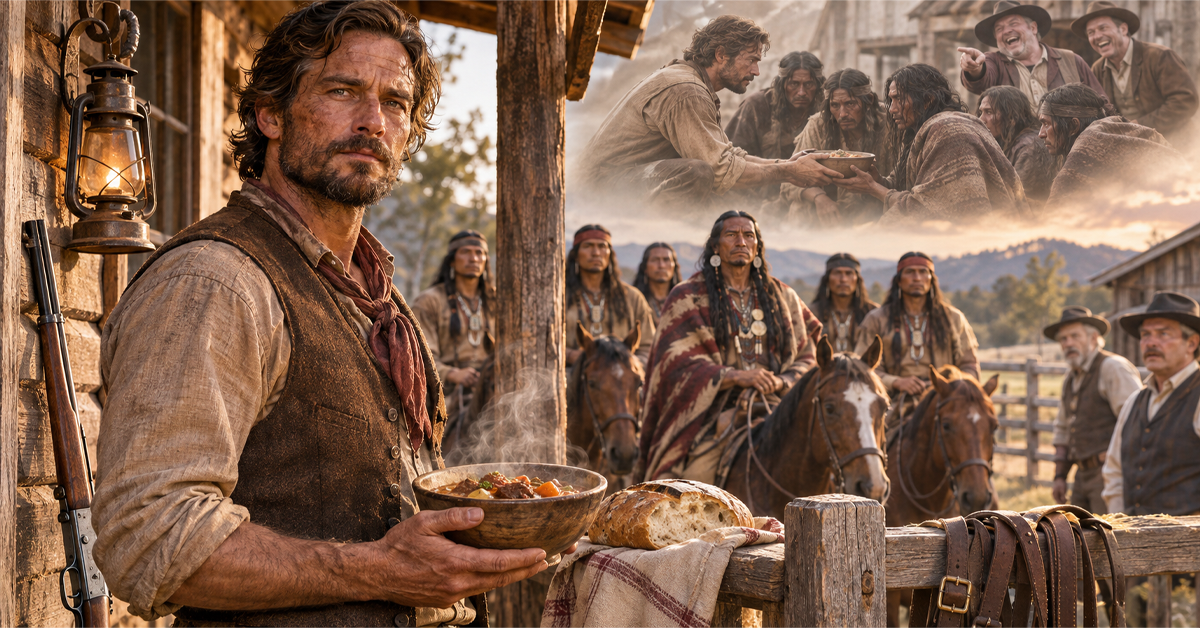
The day I lowered my rifle before six starving Apache strangers was the day I unknowingly saved my own life.
My name is Samuel Carter, and in the spring of 1874, I was forty-three years old, living alone on a modest cattle ranch in Arizona Territory, where a man’s survival usually depended more on his caution than his compassion.
I had survived the Civil War, buried the woman I loved, and spent the better part of a decade trying to build something peaceful out of a landscape that seemed determined to break everything standing upon it.
The nearest neighbor lived miles away, the nearest settlement required a long ride, and the desert beyond my fences belonged to heat, dust, rattlesnakes, and whatever trouble happened to be passing through.
People in town had warned me repeatedly about Apache travelers.
Some of their stories concerned genuine violence, while others had traveled through so many frightened mouths that nobody could separate truth from invention anymore.
The advice was always the same.
“Never let them near your property.”
I had repeated those words to myself often enough that they seemed like common sense rather than an opinion I had inherited from other men.
Then came the afternoon that changed everything.
I was repairing the western corral when my horse suddenly raised his head and stared toward the ridge.
His ears stood straight, and his body stiffened with the nervous attention of an animal that had noticed something long before his owner.
I set down my hammer and followed his gaze.
Six figures were moving through the shimmering afternoon heat, slowly descending from the rocky ground toward my ranch.
At first, all I could see were silhouettes beneath the merciless sun.
I reached for the Winchester leaning against a fence post.
As they approached, their shapes became clearer, and I realized that I was looking at two elderly men, two women, and two young children.
All six were Apache.
My grip tightened.
I searched the ridgeline behind them, expecting to discover riders or armed men watching from a distance.
Nothing moved among the rocks.
When I looked back, one of the children stumbled.
He was a small boy, perhaps five years old, with dust covering his clothing and hair.
His knees folded beneath him, and he dropped onto the hard ground without even trying to catch himself.
One of the women hurried toward him, but she nearly fell before reaching his side.
The second child stood close to the other woman, swaying with exhaustion.
I had seen enough suffering during the war to recognize the condition of those people.
Their blankets hung loosely from their shoulders, their faces were hollow, and their movements had the terrible slowness of bodies running out of strength.
The oldest man stopped well beyond my fence.
He raised one empty hand and waited.
I kept the rifle pointed toward the ground but ready.
“What do you want?”
The elder swallowed before answering.
“Please,” he said in strained English, “water.”
His eyes moved toward the children.
“Children need water.”
I studied his face.
He seemed old enough to have seen more hard seasons than I could count, and the lines around his eyes were deep enough to hold the desert dust.
“Where are your horses?”
“Gone.”
“Your weapons?”
He spread his hands.
“We come with children.”
I looked again toward the western ridge.
“Anybody following you?”
The man hesitated before shaking his head.
“Fighting scattered families.”
He gestured toward the mountains.
“We walk many days.”
The second elderly man leaned against a younger woman’s shoulder, too exhausted to remain steady.
The first elder continued speaking in short, careful phrases.
They had lost their horses, exhausted their water, and eaten almost nothing for two days.
They wanted enough food and water to continue north.
That was all.
I wish I could say I believed him immediately.
I did not.
For years, I had listened to neighbors insist that kindness toward strangers was dangerous, especially when those strangers belonged to a people whom settlers had learned to fear.
I understood the risks of opening my property to unknown travelers.
I also understood that a desperate person could become dangerous.
Yet every argument inside my head weakened whenever I looked at the little boy lying beside his mother.
His lips were cracked, and his face had that frightening stillness I remembered seeing on hungry children during the war.
Once, in Virginia, I had watched civilians emerge from a ruined farmhouse after days without enough food.
There had been a little girl among them whose eyes seemed too large for her face.
I had carried water to that child while officers shouted instructions around us.
For years afterward, I remembered her drinking with both hands wrapped around a tin cup.
Looking at the Apache boy, I suddenly felt as though the battlefield had followed me all the way into Arizona.
I lowered my Winchester.
“Stay where you are.”
The elder nodded.
I walked toward the well without turning my back completely.
Even then, part of me remained ashamedly suspicious.
The iron bucket rattled against the stone lining as I lowered it into the cool darkness.
When I drew it up, the water glittered beneath the afternoon sun.
I poured it into tin cups and carried them back.
The first woman stepped forward cautiously.
I handed her a cup.
She did not drink.
Instead, she knelt beside the boy and held the cup against his lips.
He swallowed too quickly, coughing as water spilled down his dusty shirt.
She stopped him gently, allowed him to breathe, and offered the cup again.
The other woman gave her water to the second child.
Only after both children had drunk did the adults accept anything for themselves.
I watched the first woman lift an almost empty cup to her lips, taking a single careful swallow before passing it to the elderly man beside her.
Nobody needed to translate that gesture.
I had been told to see enemies when I looked at people like them.
What I saw instead were mothers willing to endure thirst so their children might survive.
Something uncomfortable shifted inside my chest.
I went back to the well and brought more water.
Then more.
The travelers drank slowly under my watch, and the color gradually returned to the children’s faces.
The elder offered a quiet word in his own language.
I shook my head.
“Water ain’t enough.”
The man looked at me without understanding.
I turned toward my cattle enclosure.
Among my modest herd stood a healthy steer I had intended to sell when I next made the trip into town.
It was one of the finest animals I owned, and its price would have paid for flour, coffee, replacement tools, and other supplies I could scarcely afford.
I stood at the gate for a long moment, considering what that animal represented.
Every steer mattered when a man owned so few.
Every lost dollar meant another hard month.
Then I glanced toward the little boy, who was still sitting on the ground with his mother’s arm around his shoulders.
I opened the gate.
By late afternoon, I had prepared meat for roasting, set a black iron pot of beans above the fire, and started baking bread in my iron oven.
The scent of cooking drifted across the yard.
The travelers watched me from beyond the fence, their expressions caught somewhere between hunger and disbelief.
I pointed toward the cottonwood trees beside the creek.
“There’s shade over there.”
The elder looked at the trees, then back at me.
“You let us stay?”
“Long enough to eat and rest.”
His eyes narrowed slightly.
“Why?”
I considered several answers, but none seemed necessary.
“Because those children need feeding.”
For the first time, the old man’s expression softened.
He translated my invitation to the others.
They gathered their blankets and began walking toward the trees.
The little boy tried to stand independently, failed, and reached for his mother’s hand.
Without thinking, I moved forward to help him.
The mother stopped.
Her body stiffened, and fear flashed across her exhausted face.
I froze immediately.
Then I slowly lowered my hand.
She looked at me for several seconds before guiding her son onward.
I understood her hesitation.
She had no more reason to trust me than I had to trust her.
When the food was finally ready, I carried bread and beans beneath the cottonwoods.
The children sat together on a folded blanket while the adults remained standing.
I motioned toward the meal.
“Go on.”
The elder studied me.
“All this food?”
I nodded.
“Everybody eats.”
He looked toward the roasting meat and then toward the cattle pen.
For a moment, he seemed unable to speak.
Finally, he placed his right hand over his heart.
The others sat down.
The little boy reached for a piece of bread, and his mother gently caught his wrist, apparently reminding him to wait.
I placed the bread directly before him.
“He’s waited long enough.”
The child looked at his mother.
She nodded.
He began eating.
I sat a short distance away and watched six exhausted strangers share a meal beneath the trees I had planted years earlier.
For the first time since my wife’s death, the ranch no longer felt entirely empty.
Then the elder rose, approached me slowly, and pointed toward the steer I had sacrificed.
His expression became serious.
“Samuel Carter,” he said after learning my name, “you understand what you have given?”
I looked at the children.
“Enough to keep them walking.”
The old man shook his head.
“No.”
He placed his hand against his heart.
“You give more than food.”
And as the evening shadows stretched across my ranch, I realized that something important was being offered in return, although I had no idea what it might mean.
CHAPTER 2: THE PROMISE BENEATH THE COTTONWOODS.
I stood beneath the cottonwood trees listening to the elderly Apache man, uncertain whether I had understood the meaning of his words.
He was looking not at the meal but at me, his weathered face illuminated by the last orange light of the afternoon.
I had fed hungry people before.
During the war, soldiers shared food whenever they could, and civilians sometimes survived because strangers gave away what little they possessed.
Yet the elder regarded my decision with a solemnity that made the ordinary act of cooking dinner seem like something larger.
“You give more than food,” he repeated.
I glanced toward the children.
“Maybe you ought to save your strength instead of talking.”
He smiled faintly.
It was the first smile I had seen from any of them.
The older woman beside him spoke several quiet sentences in Apache.
He listened, then nodded.
“She says children will remember this place.”
I looked toward the boy, whose hands were occupied with a piece of bread nearly as large as his face.
“Children ought to remember better things than being hungry.”
The elder studied me for another moment.
Then he returned to his family.
I had never imagined that silence could be so different depending on who shared it.
For years, the quiet around my house had been something I endured.
At night, the wind rubbed dry branches against the walls, and the empty rooms seemed to hold their breath.
There had been a time when those rooms sounded different.
My wife had enjoyed singing while working, never loudly, just enough to make ordinary chores seem less burdensome.
After I buried her, I stopped noticing music.
I noticed only its absence.
Now, beneath the cottonwoods, the low voices of two women and the occasional movement of the children filled the evening with unfamiliar life.
I remained near the fire, turning the remaining meat and making certain the beans did not burn.
One of the women approached with an empty cup.
She did not speak English, or at least she did not attempt to use it.
Instead, she held out the cup and pointed toward the well.
I nodded.
“Of course.”
I filled it and carried another cup back for the boy.
He accepted the water with both hands.
His mother spoke softly to him.
He looked at me and gave a small, uncertain smile.
It was such an ordinary expression that I felt unexpectedly embarrassed by the pleasure it brought me.
I had feared these people for years without knowing any of them.
Now a hungry child had smiled at me, and I could not remember why that had ever seemed impossible.
As darkness approached, I gathered additional firewood.
The two elderly men watched while I arranged the logs.
One of them rose to assist me, but I waved him back toward the blanket.
“You’ve done enough walking.”
He did not understand the words, yet he understood the gesture.
He sat again.
The women began dividing the remaining bread into small portions.
I noticed that they were setting some aside rather than eating everything.
I pointed toward the bread.
“You can have more.”
The elder translated.
One woman gestured northward.
They were preparing for the journey.
I understood then that they were thinking beyond the immediate comfort of a full stomach.
Tomorrow would bring another day beneath the sun.
They would need food after leaving my property.
I went inside and found a clean flour sack.
Into it, I placed bread, dried beans, and whatever provisions I could spare without leaving myself entirely unprepared.
When I returned, the older woman stared at the sack as though she doubted it was meant for her.
“For the road,” I explained.
The elder took the sack carefully.
“You need food also.”
“I’ve got cattle.”
He looked toward the enclosure.
“Not so many.”
I could not help smiling.
“Enough for an old fool.”
The man’s expression grew puzzled.
I explained that some people in town would consider me foolish for helping strangers.
His smile disappeared.
“Your people say this?”
“Some would.”
He looked away toward the western mountains.
For a moment, the only sound was the steady movement of the creek.
Then he said something I would remember long afterward.
“Men afraid often forget what they see.”
I considered his words.
He was not accusing me.
That made the truth harder to avoid.
I had seen six exhausted travelers, yet my first instinct had been to imagine hidden warriors waiting to attack.
The elder had seen an armed rancher, and perhaps his first instinct had been equally fearful.
Both of us had approached the meeting carrying stories about the other.
Only hunger had forced us to discover something different.
As the temperature dropped, I offered the travelers the shelter of my barn.
They discussed the invitation among themselves.
The elder eventually shook his head.
“Trees good.”
I suspected that enclosed walls would make them uneasy.
Perhaps they preferred to watch the surrounding ground.
I did not insist.
Instead, I carried out two additional blankets.
The little boy was already asleep, his head resting against his mother’s shoulder.
The second child leaned against the older woman, struggling to keep her eyes open.
The woman’s fingers moved gently through the child’s hair.
I stood there longer than necessary.
A memory rose unexpectedly of my wife sitting beside our fireplace, brushing dust from my coat after a long day.
For a heartbeat, grief pressed against my ribs with the same force it had carried on the morning I buried her.
I turned away before anyone noticed.
Inside the house, I opened the small wooden box where I kept her belongings.
A faded ribbon lay beside a few letters and the wedding ring I could not bring myself to put away.
I touched the ribbon and remembered how she used to say that a home was measured by the comfort it offered rather than the money it contained.
She had believed that people revealed themselves most clearly when they had something to lose.
I had thought about those words often during the war.
I thought about them again while six strangers slept outside.
The following morning, I rose before sunrise.
The travelers were already awake.
The women had folded their blankets, and the elderly men were standing beside the creek.
The children looked stronger, although the journey had clearly left them exhausted.
I prepared another simple meal.
Nobody refused.
After eating, the elder approached my porch.
He held the sack of provisions in one hand.
“You are alone here?”
“Most days.”
“No family?”
I hesitated.
“Not anymore.”
His expression changed, and I knew he understood enough without further explanation.
He looked toward the house, the cattle, and the corral.
“Lonely place.”
“Sometimes.”
He nodded slowly.
Then he placed his right hand over his heart.
With his other hand, he pointed toward the mountains.
“We remember.”
I gave a small nod.
“Just get those children somewhere safe.”
He repeated the gesture, and the other adults followed his example.
The boy raised his small hand in farewell.
I lifted mine.
Then the six travelers began walking toward the northern trail.
I watched them move slowly between the rocks.
The morning sun caught the dust beneath their feet, and their figures gradually became smaller against the immense wilderness.
After a while, the boy turned and looked back.
His mother took his hand.
They disappeared beyond the ridge.
I stood alone beside my fence.
The cattle shifted in their enclosure, and my horse lowered his head to graze.
Everything looked exactly as it had before their arrival.
Yet something fundamental had changed.
For years, I had believed survival meant keeping every stranger at a distance.
Now I had shared my water, my bread, and one of my best steers with people whose names I did not even know.
I wondered what the ranchers in town would say if they learned what I had done.
I already knew the answer.
What I did not know was that three weeks later, with fifteen armed men outside my house, I would find myself thinking desperately about those six figures vanishing into the mountains.
And by then, the question would no longer be whether my kindness had been foolish.
It would be whether kindness could possibly reach across the desert in time to save my life.
CHAPTER 3: THE PRICE OF A GOOD DEED.
During the weeks after the Apache travelers departed, I returned to the habits that had kept my ranch operating for years, but I discovered that ordinary work no longer felt quite the same.
Every morning, I inspected the cattle, repaired fences, checked the water supply, and measured my remaining provisions.
The missing steer was impossible to overlook.
My herd had never been large, and sacrificing one of its healthiest animals meant surrendering money that would have helped carry me through the next season.
I did not regret the decision.
I did, however, have to live with its practical consequences.
There was less flour than I wanted in the pantry, my coffee supply was dwindling, and several worn tools needed replacing.
I had planned to purchase those things with the proceeds from the steer.
Now I would have to manage without that money.
I had known the cost before making my choice, which seemed reason enough not to complain.
Still, there were evenings when I sat at the kitchen table counting coins and wondered how long a man could keep making hard choices before one finally overwhelmed him.
At such moments, I remembered the little boy collapsing in the dust.
The arithmetic became easier.
A steer could be replaced.
A child’s life could not.
I had heard the old saying that no good deed went unpunished.
I had never cared much for it.
The people who repeated it most enthusiastically were often those who had little interest in helping anybody.
Yet I knew that kindness did not guarantee safety, prosperity, or gratitude.
The desert made no promises to generous men.
It offered the same heat and hardship to everyone.
One morning, while checking the western fence, I discovered an impression in the soil left by a small foot.
The tracks from the travelers had mostly disappeared beneath windblown dust, but this one had survived in a sheltered patch beside the corral.
I knelt and studied it.
It belonged to one of the children.
For several minutes, I remained there remembering the way the boy had struggled to lift his head before drinking.
The image made me think again about how easily people became abstractions when described from a distance.
A traveler called a threat was simple to hate.
A child with cracked lips was not.
I stood and brushed the dust from my knees.
The fence required another hour of work.
I returned to it.
On the following afternoon, I rode toward the northern edge of my property to inspect a stretch of wire damaged by an animal.
The land rolled into low, rocky hills before rising toward the mountains.
From that distance, my ranch house looked small enough to disappear beneath a man’s thumb.
I had chosen the location because the creek offered water and the surrounding grass could sustain a modest herd.
I had also chosen it because I wanted to be left alone.
After the war, isolation had seemed like peace.
I wanted no more orders shouted over cannon fire, no more frightened men calling for help, and no more decisions made while blood soaked the ground.
A ranch had seemed an honest solution.
Cattle did not care what uniform a man had worn.
Fence posts did not ask why he sometimes woke shaking.
The mountains offered no questions about the friends he had buried.
I had believed that distance from other people would protect me from grief.
Years later, I understood that grief could travel anywhere.
It had followed me into the kitchen, the barn, the corral, and the quiet hours before sunrise.
What I had not expected was for six strangers to disturb that loneliness simply by accepting a meal.
As I worked, I found myself listening for human voices.
The realization annoyed me.
I had spent years convincing myself that solitude was exactly what I wanted.
Now I missed the sounds of people whose language I could barely understand.
I returned home before sunset.
That evening, I cleaned my Winchester and checked the revolver I kept near my bed.
The habit came from the army.
A neglected weapon could fail when a man needed it most.
I had no wish to fight anyone, but the territory contained enough danger to make readiness necessary.
I counted my ammunition.
The supply was smaller than I liked.
I made a note to purchase more when I next visited town.
My thoughts returned to the warning stories I had heard about raids, stolen livestock, and violent confrontations.
I knew some of those incidents had happened.
I also knew that a man’s identity did not tell me whether he intended harm.
I had just fed six Apache travelers who had threatened nothing and stolen nothing.
The men who robbed ranches along the southern trails, meanwhile, were often settlers who spoke my language.
That distinction had become difficult to ignore.
Two days later, I found myself considering whether I should tell anyone about the travelers.
There was no practical reason to keep the encounter secret.
I had broken no law by feeding hungry people.
Yet I could almost hear the remarks that would follow.
Some men would laugh.
Others would accuse me of inviting danger onto the ranch.
A few might insist that the travelers had been scouting for raiders.
I could not prove what any of them might believe.
I could only describe what I had seen.
Six exhausted people had asked for water.
I had given them a meal.
They had left peacefully.
The simplicity of that account made the imagined accusations seem absurd.
Nevertheless, I kept the experience mostly to myself.
I had no desire to defend a decision that needed no defense.
When the third week began, supplies grew low enough that postponing a trip into town was no longer sensible.
I prepared a list.
Flour, coffee, ammunition, nails, a replacement hammer, and several other tools went onto the paper.
I checked the saddle on my horse and considered the route.
The journey would take much of the day.
I would leave early and return before dark.
Before departing, I inspected the corral gate and checked the cattle.
The animals were healthy, although I noticed that one section of the outer fence had loosened again.
I made a mental note to repair it after returning.
As I stood beside the enclosure, I remembered the steer I had sacrificed.
The expense still troubled my accounts, but the thought no longer carried any bitterness.
I had made my choice.
That was enough.
The following morning, I saddled my horse before the sun rose above the hills.
The air was cool, and the ranch lay beneath the blue-gray shadows of dawn.
I locked the house, secured the barn, and mounted.
At the edge of the yard, I paused.
Something about the stillness felt strange.
I listened carefully.
There was no sound beyond the ordinary movement of cattle and the distant murmur of the creek.
I told myself that I was imagining trouble.
Then I looked toward the western ridge where the six travelers had first appeared.
The mountains stood motionless against the brightening sky.
For an instant, I wondered whether the old Apache man had reached his people safely.
I hoped the children were eating well.
I hoped their families had been reunited.
I hoped they had found a place where no frightened rancher would meet them with a rifle.
Then I turned my horse toward town.
I rode away believing the day would bring nothing worse than expensive supplies and a long journey home.
I had no idea that before sunset, I would hear a name capable of making even hardened ranchers lower their voices.
That name was Wade Mercer.
CHAPTER 4: THE NAME THAT SILENCED THE GENERAL STORE.
I had just stepped inside the general store when I noticed that the usual conversation had gone unusually quiet.
The place smelled of coffee beans, leather, flour, and the dry wood of shelves that had stood through countless hot summers.
Normally, men gathered near the counter arguing about cattle prices, weather, politics, and anything else that gave them an excuse to avoid going home.
That afternoon, nobody seemed interested in argument.
I removed my hat and approached the counter.
“Afternoon.”
The storekeeper nodded without smiling.
“Samuel.”
I handed him my list.
“Need what you’ve got of these.”
He studied the paper.
His eyes stopped at the ammunition.
“Reckon you’re not the only one buying cartridges today.”
I looked around.
Several men avoided my gaze.
“Something happened?”
The storekeeper placed my list on the counter.
Before he answered, the sheriff stepped forward from the rear of the room.
“Mercer’s moving through this country.”
The name settled over the store like a sudden drop in temperature.
I had heard of Wade Mercer.
Anybody who owned livestock in that part of the territory had heard of him.
He commanded a gang of horse thieves and cattle rustlers who moved between isolated settlements, stealing whatever they could carry or drive away.
There were stories of ranchers losing entire herds.
There were accounts of barns burned after owners refused to cooperate.
Other men had disappeared, and nobody knew whether they had fled the territory or been killed.
I understood that stories grew as they traveled.
Even so, enough of Mercer’s reputation had been confirmed to make him dangerous.
“How close?”
I asked.
“Close enough that I wouldn’t sleep easy on an isolated ranch.”
The sheriff’s expression remained grim.
“Especially one with no neighbors nearby.”
I felt the warning strike its intended target.
My property stood miles from the nearest homestead.
A man could shout himself hoarse there without anyone hearing him.
“What do we know for certain?”
The sheriff rested one hand on the counter.
“Several reports of stolen horses and cattle, and riders matching his men’s descriptions have been seen along the trails.”
“Anybody hurt?”
“Threatened, certainly.”
He paused.
“Some of those who resisted haven’t been seen since.”
I glanced toward the other customers.
Their expressions told me they had been discussing the same subject before I entered.
One man shifted uneasily.
“Fifteen riders, they say.”
I looked at him.
“Fifteen?”
“Mercer and fourteen others.”
I considered the number.
During the war, I had faced larger groups of armed men, but that had been with soldiers beside me and a commanding officer directing our movements.
Fifteen riders approaching a lone ranch house were another matter entirely.
“What are you doing about it?”
I asked the sheriff.
“Trying to establish where they’re operating.”
He spread his hands slightly.
“Territory’s too large, and I’ve too few men to guard every ranch.”
I knew he was telling the truth.
Law traveled slowly across those distances.
Sometimes it arrived after the damage had already been done.
The storekeeper began gathering my supplies.
He placed flour and coffee on the counter, followed by the tools I had requested.
When he reached the ammunition, he frowned.
“Not as much left as you’d probably like.”
“Give me what you’ve got.”
He opened a wooden drawer and counted the available cartridges.
I watched the small pile accumulate.
It was less than I had hoped.
“Any more coming?”
“Not before your ride home.”
I took everything he could sell me.
The total cost more than I wanted to spend.
I paid anyway.
There are moments when money loses its importance beside the possibility of needing a loaded rifle.
The sheriff followed me outside as I secured the packages to my saddle.
“Samuel.”
I turned.
He glanced toward the surrounding street before continuing.
“You live alone out there.”
“I know where I live.”
“I’m serious.”
“So am I.”
He studied me for a moment.
“Lock things down when you get home.”
I nodded.
“Already planning to.”
“If anybody comes asking about your cattle, don’t assume they’re ordinary buyers.”
I tightened the saddle straps.
“You think Mercer might come my way?”
“I think he’d prefer a place where nobody can hear the shooting.”
The words were spoken quietly.
That made them worse.
I mounted.
The sheriff rested a hand against the saddle.
“Be careful.”
“I will.”
I rode out of town with a heavier load and a considerably darker mood than when I arrived.
For much of the journey, I kept thinking about what fifteen armed men could do to a lonely ranch.
I had worked years to build my home.
The house was small, but I knew every board and nail.
I had planted the cottonwoods, dug drainage channels, reinforced the barn, and slowly increased the herd.
The land held nearly everything I owned.
More importantly, it held the life I had struggled to create after surviving a war that had taken so much from me.
The thought of Mercer riding through my gate and claiming it all made my stomach tighten.
I urged my horse onward.
The desert heat rose around us.
I checked the surrounding ridges more often than usual.
Whenever I saw dust in the distance, I searched for riders.
Most of the time, the movement came from wind crossing the dry ground.
I told myself not to become foolish with fear.
Still, my hand remained close to the rifle.
As the sun began descending, familiar landmarks appeared.
I recognized the rocky slope east of my property and the shallow wash where rainwater occasionally gathered.
Then the outer fence came into view.
I slowed my horse.
Something was wrong.
At first, I could not identify it.
The cattle seemed unsettled, and the ground near the fence looked disturbed.
I rode closer.
Fresh hoofprints crossed the dust.
Dozens of them.
They entered from the direction of the western trail, circled the cattle enclosure, and continued toward the ranch house.
I dismounted immediately.
My horse shifted nervously as I knelt beside the tracks.
The impressions were sharp.
Whoever had made them had passed recently.
I followed several sets of prints toward the corral.
They stopped near a point where the herd could be counted easily.
Other tracks led closer to the barn.
I walked toward the house and discovered more impressions near the front yard.
The riders had not simply crossed my land.
They had examined it.
I looked at the fence posts, the narrow gate, and the clear approaches from the north and west.
A man studying my ranch would learn quickly that there were only a few places from which I could defend the house effectively.
He would also learn that there was no nearby help.
I stood very still.
An old sensation returned, one I had not experienced so sharply since the war.
It was the feeling of discovering that an enemy had been close enough to study your position while you remained unaware.
I scanned the hills.
Nothing moved.
No smoke rose from the ridge.
No rider appeared among the rocks.
The silence offered no reassurance.
I crouched again beside the nearest track.
The depth of the impression suggested a heavily burdened horse or a large rider.
I could not identify Wade Mercer from a hoofprint.
I knew that.
But the sheriff’s warning was fresh in my mind, and the evidence before me fit it too closely for comfort.
Someone had counted my cattle.
Someone had inspected my defenses.
Someone knew that I lived alone.
I straightened and looked toward the darkening sky.
The first stars would appear within hours.
I had a rifle, a revolver, and far fewer cartridges than fifteen armed men would require.
As I led my horse toward the barn, a dreadful certainty settled over me.
The riders had not come to steal anything that afternoon.
They had come to decide how easily they could take everything when they returned.
CHAPTER 5: THE LAST LIGHT IN SAMUEL CARTER’S HOUSE.
I began preparing the ranch for an attack before I had even finished unloading my supplies.
The hoofprints told me enough.
Someone had examined my property while I was away, and whoever those riders were, they had shown considerable interest in the cattle, the barn, and the approaches to my house.
I could not know whether they intended to return that evening.
I could not afford to assume they would not.
I led my horse into the barn and secured the doors.
Then I hurried toward the cattle enclosure.
The animals crowded together uneasily as I moved them into the strongest section of the corral.
I checked the gate twice.
One hinge had begun to loosen, so I fetched the tools purchased in town and reinforced it as quickly as I could.
My hands moved with the efficiency of years spent repairing things before bad weather arrived.
Yet this was no ordinary storm.
A broken fence could be rebuilt.
A stolen herd could ruin me.
A visit from Wade Mercer might leave nobody alive to worry about either.
I worked until sweat soaked the back of my shirt.
The sun dropped toward the western mountains, bathing the rocks in copper and crimson.
Ordinarily, I enjoyed that hour.
The heat weakened, the cattle settled, and the land seemed briefly willing to forgive everything the afternoon had demanded.
Now every lengthening shadow looked capable of concealing a rider.
I carried water into the house and placed it near the kitchen table.
I wanted no reason to step outside after dark.
Next, I brought in the flour, coffee, and other supplies, not because I expected to need them immediately but because the thought of leaving anything exposed troubled me.
I checked the back door.
Then the front.
Then every window.
The house had been built for shelter, not battle.
Its walls were sturdy enough against wind and rain, but rifle fire was another matter.
I had once watched soldiers place too much faith in wooden defenses.
I remembered what happened when bullets found them.
The windows worried me most.
They offered a view of the yard, yet they also gave anyone outside a clear indication of where I might be standing.
I closed the shutters where possible and left narrow spaces through which I could observe the approaches.
As I worked, my mind kept returning to the surrounding terrain.
The western ridge offered cover.
The southern fence could conceal riders moving in darkness.
The northern boundary was more open, but a determined gang could spread along it without difficulty.
The eastern side offered little protection once a man reached the house.
I had no defensible escape route that would not expose me to gunfire if the property was surrounded.
The realization was unpleasant.
I went to the bedroom and retrieved my revolver.
Its grip felt familiar in my hand.
I checked the cylinder, then placed the weapon on the kitchen table beside my Winchester.
Afterward, I counted every cartridge I owned.
I counted them again.
There were not enough.
Even if my aim remained steady, I could not hope to stop fifteen determined men in a prolonged fight.
I had survived the war partly because I knew when not to waste ammunition.
Now the memory of those lessons offered little comfort.
I arranged the cartridges where I could reach them quickly.
For several moments, I stared at the small supply.
The sheriff had warned me.
The hoofprints had confirmed the danger.
Yet nothing I had done could change the fact that I was alone.
I considered leaving the ranch before nightfall.
My horse was already inside the barn, and I knew the country well enough to travel by starlight.
If I abandoned the property, perhaps I could reach the settlement and return with the sheriff.
But leaving meant surrendering the cattle and everything I had worked to build.
There was also no guarantee that the riders were not watching from beyond the hills.
A lone man crossing open ground would make an easy target.
I stood beside the table, struggling with the decision.
My instinct told me to protect what belonged to me.
My experience told me that property was not worth dying for.
I had seen men make foolish last stands over positions that mattered less than the lives lost defending them.
I did not want my ranch to become another meaningless battlefield.
Yet I could not bring myself to walk away without knowing whether danger would actually arrive.
Finally, I carried a chair near the front window and sat.
The house grew quiet.
Outside, the cattle shifted, and the evening breeze moved through the cottonwoods.
I looked toward the trees.
Three weeks earlier, six starving people had rested beneath them.
For a little while, my ranch had been filled with voices other than my own.
I could almost see the small boy holding a tin cup in both hands.
I remembered his mother stopping him from drinking too quickly.
I remembered the second child leaning against the older woman, fighting sleep.
Most clearly, I remembered the elder pointing toward the mountains.
“We remember.”
The words returned with unexpected force.
I wondered where those travelers were now.
Perhaps they had reached their families.
Perhaps they had crossed the mountains and found shelter.
Perhaps the children were sitting beside another fire, warm and safely fed.
I hoped so.
The thought comforted me, even though it offered nothing practical against the danger approaching my own home.
I rose and walked into the bedroom.
The small wooden box containing my wife’s belongings rested where it always had.
I opened it.
Her ribbon lay folded beneath the letters.
I touched it gently.
She had never known this ranch at its present size.
When we first came west, everything had seemed uncertain.
We had spoken about the future as though hard work alone could guarantee that it would arrive.
I remembered her laughing while rain leaked through the roof of our first shelter.
She had placed a cooking pot beneath the water and declared that at least we would have something to complain about when we were old.
We never reached that age together.
I closed the box.
For years, I had treated the ranch as the last surviving piece of our shared hopes.
Losing it felt almost like losing her again.
Yet her memory also reminded me that a house and a stretch of land were not the same as a life.
I returned to the kitchen.
The sun disappeared.
I extinguished the lamps.
The darkness filled every corner.
I sat with my Winchester across my knees and listened.
An hour passed.
Then another.
The creek murmured beyond the cottonwoods.
A night bird called somewhere in the distance.
I began wondering whether the riders had moved on.
Perhaps the hoofprints belonged to men who had decided my ranch was not worth the trouble.
Perhaps I was preparing for an attack that would never come.
Then my horse made a sharp, frightened sound from the barn.
I stood immediately.
The cattle shifted against the corral.
A faint vibration traveled through the still night.
At first, I thought it was distant thunder.
Then I recognized the rhythm.
Hoofbeats.
One horse became several.
Several became so many that the sound seemed to spread across the entire western approach.
I moved toward the window.
Dark shapes appeared beyond the fence.
Five riders emerged from the west.
Four more moved around the southern boundary.
Others spread across the northern side, closing the open ground between the ranch and the hills.
I counted as carefully as I could.
Nearly fifteen men.
My mouth went dry.
The riders positioned themselves beyond the house, and the moonlight flashed across rifle barrels.
One broad-shouldered man separated himself from the others.
He wore a battered black hat and sat his horse with the easy confidence of someone accustomed to frightening people.
Even before he spoke, I knew who had come.
Wade Mercer stopped beyond my gate.
For several seconds, he studied the darkened house.
Then he leaned forward.
“Carter!”
His voice carried across the yard.
“I know you’re in there!”
I raised my rifle.
“What do you want?”
Mercer laughed.
“Your cattle, your horses, and anything else worth taking.”
“You’re not getting them.”
The laughter stopped.
Mercer slowly turned toward his men.
Then he looked back at my house.
“You’re one man, Carter.”
He gestured toward the surrounding riders.
“I’ve got fourteen more behind me.”
I tightened my grip on the Winchester.
Mercer rested his hand on his revolver.
“So I’ll ask you just once.”
His voice became cold and deliberate.
“Are you going to open that gate and walk away alive, or are you going to make us bury you right here?”
I stared through the darkness at the rifles pointed toward my home.
And for the first time since the war, I understood that I might be only seconds away from dying.
CHAPTER 6: FIFTEEN RIFLES UNDER AN ARIZONA MOON.
Wade Mercer waited beyond my gate with fourteen armed riders behind him, and I knew that every second of silence was making the situation more dangerous.
The moon had risen high enough to illuminate the corral and the open ground between the fence and my house.
Mercer’s horse stood calmly beneath him.
The other animals shifted and tossed their heads, their riders holding the reins loosely while watching the windows.
I kept my Winchester raised.
“You’re trespassing,” I called.
Mercer laughed without amusement.
“That supposed to frighten me?”
“No.”
I drew a careful breath.
“It’s supposed to tell you that this ranch belongs to somebody.”
Mercer leaned back in his saddle.
“I know who it belongs to.”
He looked toward the cattle enclosure.
“That’s why I’m here.”
I could make out the faces of several men beneath their hats.
They were watching the house with the alert concentration of hunters waiting for movement.
Some carried rifles across their saddles.
Others held their weapons ready.
Every man seemed comfortable with the possibility of violence.
Mercer gestured toward the barn.
“Open the gate, Carter.”
I did not move.
“Take your men and leave.”
His expression hardened.
“You think you’ve got enough bullets to make that happen?”
The question struck too close to the truth.
I had counted my ammunition.
I knew precisely how little stood between me and fifteen men who could surround the house from every direction.
I kept my voice steady.
“Enough to make you regret trying.”
Several of the riders shifted.
Mercer smiled.
“Maybe.”
He glanced at the nearest men.
“But I reckon you’ll run out before we do.”
I said nothing.
During the war, I had learned that men sometimes talked themselves into courage when nobody interrupted them.
I hoped Mercer might make the mistake of speaking too long.
He seemed willing.
“I’ve ridden past this place before.”
His eyes traveled across the property.
“Nice little setup you’ve got.”
I felt anger rise.
The fresh hoofprints flashed through my memory.
“You were here this afternoon.”
Mercer shrugged.
“Somebody had to see what was worth taking.”
I had suspected as much.
Hearing him admit it made the threat real in a different way.
Those men had studied the ranch while I was absent.
They had inspected my home as though it were already theirs.
Mercer continued.
“Good cattle, water nearby, decent buildings.”
He smiled again.
“Shame to waste all that on one stubborn old soldier.”
I stiffened.
He knew about my military service.
Perhaps someone in town had mentioned it.
Perhaps he had asked questions while scouting the area.
Either way, it meant he had prepared for this confrontation more carefully than I wanted to believe.
“What happens if I open the gate?”
Mercer spread his hands.
“You step aside.”
“And my cattle?”
“They come with us.”
“My horse?”
“That too.”
“My house?”
He glanced toward the building.
“Anything useful.”
I thought about the tools, the supplies, the rifle, and the few possessions my wife had left behind.
Mercer was demanding not merely livestock but the means to continue living there.
He would leave me standing on my own land without enough resources to survive comfortably.
I understood that refusing could cost my life.
I also understood that accepting might destroy the only livelihood I possessed.
“That’s not a bargain,” I said.
Mercer’s smile vanished.
“It’s not supposed to be.”
The wind moved through the cottonwoods.
Somewhere in the corral, a steer struck the fence.
One rider turned toward the sound.
I watched him carefully.
He was positioned near the northern boundary, where moonlight exposed a broad stretch of open ground.
If shooting began, the men could fire toward the house from several directions.
I had no way to defend every approach.
Mercer rested both hands on his saddle horn.
“I heard you were a reasonable man.”
“Depends who’s asking.”
“I’ve been reasonable.”
“You came with fifteen guns.”
He smiled thinly.
“That’s how I make sure people understand.”
I had known men like him during the war.
They mistook the ability to frighten others for proof that they deserved obedience.
They enjoyed negotiations only when the other man had no meaningful choice.
I felt the old temptation to answer threats with threats.
Yet I knew that anger could get me killed.
I forced myself to breathe slowly.
“What assurance do I have that you’ll let me live?”
Mercer looked almost offended.
“My word.”
I said nothing.
His expression changed again.
“You questioning it?”
“I’m asking what it’s worth.”
The men behind him grew restless.
One shifted his rifle.
Another spat into the dust.
Mercer straightened in the saddle.
“My word’s worth more than your life right now.”
There it was.
The truth beneath the performance.
He did not consider my life equal to his convenience.
I looked toward the darkness beyond the riders.
No lights shone from neighboring houses.
No voices came from the hills.
The sheriff was miles away.
I had made my home in isolation, and now isolation had become my greatest weakness.
I wondered whether my horse could escape if I opened the barn and attempted to ride through the southern fence.
The thought lasted only a moment.
Mercer’s men would see the movement before I reached the saddle.
I might manage to shoot one or two attackers.
Perhaps even more if they approached carelessly.
But the others would close around the house.
I had no illusions about the outcome.
Mercer called again.
“Last chance, Carter.”
I swallowed.
“You said that already.”
He laughed softly.
“Then maybe you’re running short of chances.”
I looked at the rifle in my hands.
The worn wood had accompanied me through years of ranch work.
It had brought down predators and occasionally supplied meat when circumstances demanded it.
I had never wanted to point it at another human being again.
The war had taken enough lives.
Now I was being asked to choose between submission and another night of bloodshed.
I thought about the six Apache travelers.
They had approached my fence unarmed and asked for water.
I had nearly met them with suspicion because of stories told by frightened men.
Mercer had approached with rifles and openly demanded my property.
There was no uncertainty about his intentions.
I remembered the elderly Apache man’s hand pressed against his chest.
“We remember.”
The words seemed painfully distant.
He was somewhere beyond the mountains.
He could not hear the man threatening me.
Nobody could.
Mercer suddenly drew his revolver.
I raised my Winchester fully.
Every rider seemed to tense at once.
“Easy,” Mercer warned.
I kept the barrel steady.
“Then put your gun away.”
His eyes narrowed.
For several terrible seconds, I thought he would fire simply to prove that he could.
Instead, he lowered the revolver slightly.
“You’re making a mistake.”
“Maybe.”
I had made plenty of mistakes in my life.
Some had cost money.
Others had cost friendships.
A few had haunted me for years.
But something inside me refused to accept that surrendering everything to a thief was the only sensible choice.
I knew courage could become stubbornness.
I knew stubbornness could become stupidity.
Yet I could not bring myself to open the gate.
Mercer turned toward his men.
“Spread out.”
The riders began moving.
Two shifted toward the barn.
Three approached the southern fence.
Others positioned themselves where they could watch the windows.
I realized that the negotiation was ending.
Mercer looked back at the house.
“When I give the word, boys, we take what’s ours.”
My pulse hammered.
I tightened my finger around the trigger.
Then, from somewhere beyond the dark western ridge, came a strange, distant sound.
It was brief and sharp, almost lost beneath the wind.
Every horse in Mercer’s gang suddenly lifted its head.
And while Mercer turned toward the mountains, I realized that something out there had frightened the animals more than the rifles surrounding my house.
CHAPTER 7: THE SOUND BEYOND THE WESTERN RIDGE.
For several seconds after the strange sound came from beyond the western ridge, nobody moved.
The horses remained restless, their ears turning toward the darkness.
Mercer’s mount stamped one hoof.
Another animal tossed its head hard enough to make its rider tighten the reins.
I had heard the sound only once.
It might have been an animal call.
It might have been a distant warning.
I could not tell.
The desert carried noises in unexpected ways, especially after sunset, when cooler air settled across the rocky ground.
Mercer looked toward the western slope.
“What was that?”
One of his men answered.
“Don’t know.”
Another rider shifted uneasily.
“Could be somebody up there.”
Mercer turned sharply.
“Then keep your eyes open.”
I remained inside the house with my Winchester raised.
I wanted desperately to believe that help had arrived.
But hope could be dangerous when it persuaded a man to abandon caution.
The sound might have had nothing to do with me.
It might have come from a creature moving among the rocks.
It might have been caused by something entirely ordinary.
The ridge remained dark.
No rider appeared.
No voice called out.
Mercer studied the mountains for another moment, then returned his attention to the house.
“Nice try, Carter.”
I frowned.
“What?”
“Trying to distract us.”
“I didn’t make that sound.”
He laughed.
“Sure you didn’t.”
I considered answering, then decided against it.
The men near the southern fence had stopped moving.
Their attention was divided between my house and the western hills.
I could see that uncertainty had entered the group.
That did not make them less dangerous.
It might make them more likely to fire without warning.
Mercer gestured impatiently.
“Get back to work.”
The riders began spreading out again.
I shifted my position beside the window.
The wood beneath my hand felt rough and dry.
My heart was beating so hard that I could hear it over the wind.
I wanted to move away from the opening, but losing sight of Mercer seemed worse.
He remained near the gate, watching the house.
“You’ve got a few seconds left.”
I did not answer.
I thought about the sheriff’s warning.
I thought about the hoofprints.
I thought about how quickly an ordinary journey for supplies had become a fight for everything I owned.
Then another sound came from the ridge.
This one was lower and longer.
Several horses shifted at once.
One rider cursed as his mount stepped sideways.
Mercer’s expression changed.
He turned toward the western darkness again.
“Who’s out there?”
No answer came.
I held my breath.
The silence that followed seemed to stretch across the entire valley.
Then a figure appeared against the ridge.
At first, I saw only a dark shape standing among the rocks.
It did not approach.
It remained motionless, high enough to be visible in the moonlight.
One of Mercer’s men raised his rifle.
“There’s somebody up there.”
The figure shifted slightly.
Another appeared farther along the slope.
Then a third.
I stared.
They were too distant for me to identify.
I could not tell whether they were mounted or standing.
Their outlines disappeared whenever they moved against the darker rocks.
Mercer rode a few paces away from the gate.
“Show yourselves!”
The figures remained where they were.
I heard one outlaw mutter something I could not understand.
Another man looked toward the eastern route, apparently checking whether it remained open.
Their confidence had begun to weaken.
Mercer noticed it.
“Hold your positions!”
His voice cracked across the yard.
I recognized the command of a leader who feared losing control.
The figures on the ridge did not answer.
For a moment, I wondered whether they were ranchers who had somehow learned about Mercer’s movements.
But my nearest neighbors lived miles away.
I had told nobody that the property had been scouted.
The sheriff knew Mercer was somewhere in the territory, yet he had no reason to suspect that my ranch would be attacked that night.
How could anyone have known?
I looked toward the cottonwood trees.
Their branches moved gently above the place where the six Apache travelers had rested.
A thought formed.
I dismissed it.
The old man and his family had left three weeks earlier.
They had been walking north.
Even if they were nearby, there was no reason to believe they knew about my danger.
Then I remembered the elder’s farewell.
His hand over his heart.
His finger pointing toward the mountains.
“We remember.”
I felt a strange pressure behind my ribs.
Could it be?
I had no proof.
I could barely see the figures.
Yet the possibility was so powerful that I found myself staring at the ridge instead of Mercer.
A fourth silhouette appeared.
This one moved along the higher rocks.
Then another shape emerged near the first.
The men outside my house began talking among themselves.
I could hear fragments.
“How many?”
“Can’t tell.”
“Look over there.”
Mercer raised his revolver toward the ridge.
“Anybody up there wants trouble, come down and find it!”
The challenge echoed against the mountains.
No shot answered.
No voice responded.
The silence seemed almost deliberate.
I remembered how the Apache elder had stood beyond my fence without crossing it until invited.
He had understood the importance of distance.
Whoever occupied the ridge now seemed equally willing to wait.
Mercer’s men, however, had come expecting a frightened rancher.
They had not expected unseen observers occupying the high ground.
The difference mattered.
During the war, I had watched groups of confident soldiers become nervous the moment they suspected an enemy held a position above them.
Uncertainty could break courage more effectively than a shouted threat.
I kept that knowledge to myself.
Mercer looked back at my house.
“Carter!”
I remained at the window.
“You know those people?”
I answered carefully.
“I know you’re not the only man who can ride through this country.”
His face darkened.
“That’s not what I asked.”
“Then maybe you ought to ask them.”
The remark was bolder than I felt.
Mercer raised his revolver toward me.
“Don’t get clever.”
I tightened my grip on the Winchester.
For several seconds, neither of us moved.
Then a voice came from the western ridge.
It was distant but unmistakably human.
The words were not English.
Several other voices answered from different positions.
The outlaws looked toward the sounds.
One of the riders near the barn began backing his horse away.
Mercer shouted at him.
“Stay where you are!”
The man stopped, but his animal continued shifting nervously.
More figures appeared among the rocks.
I could not count them.
Some remained motionless.
Others moved briefly between patches of moonlight.
I knew enough about the terrain to understand that anyone positioned along that ridge could observe the entire ranch.
Mercer’s men had surrounded my house.
Now someone else seemed to be watching them.
I felt my fear changing shape.
The danger had not disappeared.
A desperate outlaw might fire at the ridge.
A frightened horse might bolt.
One mistaken movement could turn the valley into a battlefield.
But I was no longer certain that I stood entirely alone.
Then one figure moved forward onto a pale shelf of rock.
He was an elderly man.
He raised his right hand.
Even across the distance, the gesture struck me with the force of a remembered voice.
I stepped closer to the window.
My breath caught.
The man lowered his hand toward his chest.
And I recognized him.
Chapter 8: THE MEN WHO CAME BACK .
The elderly man standing on the western ridge was the same stranger who had asked me for water three weeks earlier.
I knew his face only from a brief encounter, yet something about his posture and the deliberate way he held himself left me with no doubt.
He stood where the moonlight reached the pale rock, looking down upon the armed men surrounding my ranch.
I remembered him stopping beyond my fence.
I remembered his exhausted voice.
“Please.”
Then I remembered his final words.
“We remember.”
I felt a sudden weakness in my knees.
The six travelers had disappeared into the mountains, and I had assumed our paths would never cross again.
Now the old man had returned at the exact moment when I expected to die.
I could not explain how he knew I was in danger.
I could not understand why he had come with others.
But his presence changed everything.
Mercer stared toward the ridge.
“Who are you?”
The elder did not immediately answer.
Several figures shifted behind him.
They stood among the rocks, partially concealed by darkness.
Some carried weapons.
Others remained too distant for me to see clearly.
There were enough of them to make Mercer’s men uncertain about the strength of the group.
One outlaw whispered something to another.
A horse backed away from the southern fence.
Mercer raised his voice.
“This is none of your concern!”
The elder answered in careful English.
“Leave this place.”
The words traveled clearly across the open ground.
Mercer’s expression twisted.
“That old rancher send for you?”
The elder remained still.
I gripped the window frame.
Part of me wanted to shout that I had sent for nobody.
Another part understood that silence was safer.
If Mercer believed I had arranged protection, perhaps he would reconsider the attack.
But I had no intention of claiming credit for something I had not done.
Mercer looked toward my house.
“Carter!”
I answered.
“What?”
“You got Apache men waiting up there?”
I glanced toward the ridge.
The elder stood with his hand lowered.
“I didn’t know anybody was coming.”
Mercer studied my window.
He seemed uncertain whether to believe me.
I realized that his uncertainty was useful.
He had entered my property confident that he controlled the situation.
Now he could not determine how many people occupied the ridge or why they had arrived.
One of his riders spoke urgently.
“Wade, we ought to think about this.”
Mercer turned toward him.
“Shut your mouth.”
The man looked away.
I recognized the moment.
A leader whose followers begin questioning him must either restore confidence or risk losing authority.
Mercer had built his power through intimidation.
He was not accustomed to being challenged in front of his men.
He turned back toward the elder.
“Come down here and say that again!”
The old man did not move.
“Leave.”
Mercer laughed loudly.
“You’re going to order me off this land?”
The elder gestured toward my house.
“This man gave water to children.”
I felt my throat tighten.
Mercer’s smile faded.
“What?”
The elder continued.
“Food.”
He paused, apparently searching for the right words.
“Rest.”
His hand moved toward his chest.
“He helped my family.”
I closed my eyes briefly.
There was no grand speech.
No elaborate promise.
The old man simply described what had happened beneath the cottonwood trees.
Mercer looked from the ridge to my house.
Then he laughed again, though the sound carried less confidence.
“You’re telling me this fool fed your people?”
The elder answered.
“Yes.”
One of the outlaws made a contemptuous sound.
Another shifted uneasily.
Mercer shook his head.
“Well, that explains it.”
He looked toward my window.
“Carter, you really are a fool.”
I said nothing.
Mercer continued.
“Giving away your cattle to strangers.”
He gestured toward the ridge.
“And now you’ve got yourself mixed up in something you don’t understand.”
I found my voice.
“I understood they were hungry.”
Mercer turned toward me.
“That’s all?”
“That’s enough.”
For a moment, nobody spoke.
The elder remained above us.
Behind him, the figures along the ridge watched the ranch.
I could not see their expressions.
I did not know how many were armed.
I knew only that they had not fired a shot.
Their presence alone was forcing Mercer to reconsider the easy victory he had expected.
The outlaw leader seemed to recognize it too.
He turned toward his men.
“Nobody moves unless I say.”
They obeyed, although several continued glancing toward the hills.
I watched their horses.
The animals remained restless.
A few were turning their heads toward sounds coming from beyond the visible ridge.
There might have been additional people farther back.
There might have been only echoes and moving shadows.
I could not tell.
Mercer could not tell either.
That uncertainty had become the most important fact in the valley.
The elder spoke again.
“Go.”
Mercer’s jaw tightened.
“Or what?”
The older man did not threaten him.
Instead, he looked toward the surrounding rocks.
One of the figures higher on the ridge moved into clearer view.
Another appeared near the southern slope.
The outlaws turned toward the movement.
Mercer followed their gaze.
I saw calculation replace anger in his expression.
He was deciding whether the ranch was worth a fight with people he could not count.
I knew that if he attacked, the consequences could be terrible.
My home stood between the two groups.
The cattle were trapped in the enclosure.
Bullets fired from either direction could strike the house or the animals.
I did not want anyone killed on my behalf.
Most of all, I did not want the elderly man who had returned to repay kindness to die because of me.
I raised my voice.
“Mercer!”
He looked toward my window.
“You can still leave.”
He stared.
I continued.
“Nobody’s taken a shot.”
Mercer’s eyes narrowed.
“You’re giving me orders now?”
“No.”
I steadied my breathing.
“I’m telling you that there’s still a way out of this without anybody dying.”
The elder said nothing.
Neither did the figures behind him.
The silence made my words seem louder.
Mercer looked around the ranch.
For the first time, he appeared to notice that his men were no longer positioned as confidently as they had been when they arrived.
Several horses faced away from the house.
One rider had lowered his rifle.
Another was watching the western trail rather than my window.
The gang had come together, but their attention was now scattered.
Mercer slowly raised his revolver.
My heart stopped for an instant.
I brought the Winchester to my shoulder.
Above us, movement rippled across the ridge.
Mercer pointed his weapon toward my house.
“If I don’t get those cattle,” he said, “somebody’s going to pay.”
I held my aim.
The elderly Apache man stepped forward.
His voice rang through the valley.
“Enough.”
Mercer turned.
The old man raised one empty hand.
Then he said something that made every outlaw look toward the dark hills.
“Many eyes see you.”
And as new shadows appeared along the ridgeline, I understood that Wade Mercer was no longer deciding how to rob my ranch.
He was deciding whether he could survive trying.
Chapter 9: THE CHOICE BETWEEN BLOOD AND MERCY.
The ridge seemed to come alive beneath the moonlight, and I watched Wade Mercer struggle to understand the danger surrounding him.
More figures had appeared among the rocks.
Some stood where their outlines were clearly visible.
Others remained half-hidden in the darkness.
I could not count them accurately, and I doubted Mercer could either.
The old Apache man stood at the center of the visible group, his bearing calm and deliberate.
He had arrived exhausted and unarmed three weeks earlier.
Now he stood above fifteen outlaws who had expected no resistance beyond one isolated rancher.
The reversal was so extraordinary that part of me wondered whether fear was causing me to imagine it.
Yet Mercer and his men were reacting to the same sight.
Their horses shifted.
Their voices dropped.
Several riders began looking for ways to withdraw.
Mercer raised his revolver higher.
“Nobody frightens me off a ranch I came to take!”
His declaration sounded more like a challenge to his own men than to anyone on the ridge.
I kept my Winchester trained in his direction.
“Then you’re going to make this worse than it needs to be.”
Mercer looked toward the window.
“You think you’re safe now?”
“No.”
The answer came honestly.
I was not safe.
The man had a loaded revolver.
His riders carried rifles.
My house offered little protection against a determined attack.
The arrival of the Apache men had changed the balance of power, but it had not removed the possibility of violence.
Mercer seemed almost pleased by my answer.
“At least you’re smart enough to know that.”
I watched him carefully.
“Nobody here has to die.”
He laughed sharply.
“You planning to preach at me, Carter?”
“I’m planning to stay alive.”
Mercer’s expression hardened.
The elder called from the ridge.
“Take your men away.”
Mercer swung toward him.
“Don’t tell me what to do!”
The old man did not raise his voice.
“Leave this place.”
Several figures along the ridge shifted their positions.
A few moved far enough into the moonlight for me to see the long weapons they carried.
The men below noticed.
One outlaw turned toward Mercer.
“Wade, there’s no sense fighting over a few cattle.”
Mercer rounded on him.
“A few cattle?”
The rider swallowed.
“We can find another place.”
The words revealed more than the man intended.
To him, my home was merely one possible target among many.
My years of labor meant nothing.
The animals I had raised meant nothing.
The little wooden box containing my wife’s possessions meant nothing.
I felt anger rise so sharply that I nearly stepped out of the house.
I forced myself to remain still.
This was not the moment for pride.
Mercer pointed his revolver toward the uncertain rider.
“You getting scared?”
The man looked away.
“I just don’t see a reason to die here.”
Other men shifted in their saddles.
Mercer understood what was happening.
His authority depended upon appearing more dangerous than anyone who challenged him.
If he withdrew too easily, his followers might no longer fear him.
If he attacked, however, they might refuse to follow.
I had seen officers confront similar choices during the war, although the stakes and circumstances had been different.
Some had accepted retreat as the price of preserving lives.
Others had sacrificed men simply to avoid appearing weak.
I could not know which kind Mercer would prove to be.
The elder stepped farther onto the pale rock.
“We do not come for blood.”
His words were steady.
“We come because this man helped children.”
Mercer stared at him.
The old man continued.
“He gave water when they had none.”
A long silence followed.
“He gave food when they were hungry.”
I remembered the little boy sitting beneath the cottonwoods.
His trembling hands had clutched a piece of bread.
I remembered the mother’s tears.
The elder looked toward my house.
“He asked nothing.”
I lowered my eyes briefly.
The words made me uncomfortable.
I had not expected reward.
I had simply been unable to watch children suffer when I possessed what they needed.
The elder faced Mercer again.
“Now we stand here.”
The meaning was clear without another sentence.
Mercer looked toward the ridge.
He looked toward his riders.
Then he looked toward my cattle.
For several seconds, I believed he was finally considering withdrawal.
His revolver lowered slightly.
I felt a cautious flicker of hope.
One of his men began turning his horse toward the western trail.
Mercer noticed.
“Hold!”
The rider stopped.
Mercer’s face had gone pale beneath the brim of his hat.
His anger was no longer controlled.
He seemed trapped between humiliation and fear.
I understood that a man in such a condition could be extremely dangerous.
I spoke carefully.
“Mercer, you’ve got a way out.”
He turned toward the house.
“Shut up.”
“Your men can leave.”
“I said shut up!”
He raised the revolver again.
I brought my Winchester firmly against my shoulder.
The old familiar pressure of the stock against my cheek carried me backward through years I had tried to forget.
For an instant, I was no longer looking through the window of my Arizona ranch.
I was staring across a battlefield at men who were just as frightened as I was.
I remembered the smoke.
The shouting.
The awful silence after a volley ended.
I had promised myself that I would never fire at another man unless I had no other choice.
That promise suddenly felt terribly fragile.
Mercer was pointing his revolver toward the window.
I had no doubt that he was capable of pulling the trigger.
If he fired, I would have to answer.
If I answered, the men on the ridge might believe the attack had begun.
Fifteen outlaws could open fire.
A single shot might turn the ranch into a killing ground.
I imagined the cottonwoods splintering beneath bullets.
I imagined cattle collapsing against the fence.
I imagined my house burning while armed men fought over the ruins.
Worst of all, I imagined the elderly Apache man dying because he had returned to help me.
I raised my voice.
“Listen to me!”
Mercer hesitated.
I continued.
“You came here because you thought I was alone.”
The statement hung in the night.
“You were right when you arrived.”
Mercer’s jaw tightened.
“But you’re not the only man who can make a choice.”
I glanced toward the ridge.
“Those people chose to stand here.”
The elder remained motionless.
“And you can choose to leave.”
Mercer swallowed.
His eyes moved toward the surrounding rocks.
Then he looked back at me.
“You think feeding six strangers makes you some kind of hero?”
“No.”
I answered without hesitation.
“I think it makes me a man who had food when somebody else didn’t.”
He stared.
I lowered my voice.
“That’s all it ever was.”
The simplicity seemed to unsettle him more than an insult would have.
For a moment, his revolver wavered.
Then one of his riders spoke.
“Wade, enough.”
Another man nodded.
“We’re leaving.”
Mercer turned toward them.
“Nobody leaves until I say!”
But the first rider had already begun backing his horse away.
A second followed.
The movement spread through the group.
Mercer looked from one man to another, his authority breaking before his eyes.
I felt the terrible tension of a moment balanced between retreat and bloodshed.
The elder raised his hand.
The men on the ridge remained still.
Nobody attacked.
Nobody shouted.
Their restraint offered Mercer one final opportunity.
He looked toward my house.
Then his expression changed.
The revolver rose until its barrel pointed directly at my chest.
I had only a fraction of a second to decide whether to fire.
My finger tightened against the trigger.
Above us, the Apache elder called out sharply.
The horses stamped and shifted.
Mercer’s eyes burned with humiliation.
And as his revolver settled on the dark opening of my window, I realized the fate of every person in that valley might depend upon what I did in the next heartbeat.
Chapter 10: THE DEBT THAT WAS NEVER ASKED FOR.
I kept my Winchester aimed at Wade Mercer while his revolver pointed directly through my window.
For one terrible moment, neither of us moved.
The desert seemed to hold its breath.
I could hear the restless horses, the faint movement of wind through the cottonwoods, and my own heartbeat pounding against my ribs.
I knew what would happen if Mercer fired.
I had no choice but to defend myself.
Yet I also understood that answering his threat with a shot might unleash the battle everyone else was trying to avoid.
The elderly Apache man remained on the western ridge with one hand raised.
His companions stood quietly among the rocks.
They had come to help me.
I would not turn their kindness into unnecessary bloodshed if there was any other choice.
“Mercer,” I said, “put it down.”
His revolver remained steady.
“You telling me what to do?”
“I’m telling you nobody has to die tonight.”
He laughed bitterly.
“You think I’m afraid of you?”
“No.”
I looked toward the ridge.
“But I think you’re beginning to understand what happens when a man believes he can take whatever he wants.”
His expression tightened.
Behind him, one of the riders shifted his horse away from the gate.
Another followed.
The gang was already beginning to withdraw, whether Mercer approved or not.
I could see that he knew it.
His authority had rested on fear.
Now his followers were more frightened of the unknown people watching from the hills than they were of their own leader.
The elder spoke again.
“Go in peace.”
Mercer turned his head slightly.
I watched the revolver carefully.
“You offering me mercy?”
The elder answered.
“Leave.”
The simplicity of the response seemed to strike Mercer harder than any threat.
He had expected an opponent who would answer anger with anger.
Instead, the old man was giving him a path away from violence.
For several seconds, Mercer remained motionless.
Then one of his riders called out.
“Wade, we’re done here.”
The outlaw leader looked over his shoulder.
Two horses had already turned toward the trail.
Others were following.
“Get back!”
Mercer shouted.
Nobody obeyed.
A rider farther south shook his head.
“We didn’t come here to fight everybody in these mountains.”
Mercer’s revolver lowered an inch.
I did not move.
He looked toward the ridge again.
The figures above us remained still.
Their refusal to attack seemed to make the decision more difficult for him.
He could not claim they had forced his hand by opening fire.
He would have to choose retreat himself.
I kept the Winchester steady.
“There’s nothing here worth dying for,” I said.
Mercer glanced toward the cattle enclosure.
“That’s easy for you to say.”
“No.”
My voice grew firmer.
“This is everything I’ve worked for.”
The words surprised even me.
I had spent years believing the ranch was all I had left of my old life.
Yet looking toward the ridge, I understood that my world had become larger than the fences surrounding it.
I had offered six people food and water.
They had returned because they believed my life mattered.
That knowledge could not be stolen with cattle.
Mercer studied me.
For one moment, I saw something beyond his anger.
It was the realization that he could no longer control what happened next.
He lowered his revolver.
Then he pointed it toward the ground.
“Mount up!” he shouted.
The order was almost unnecessary.
His men were already preparing to leave.
I watched them carefully.
No one approached the corral.
No one opened the barn.
No one attempted to enter the house.
Mercer turned his horse toward the western trail.
Before riding away, he looked back.
“This ain’t finished, Carter.”
I kept my voice steady.
“Then make sure you remember what happened here.”
His expression darkened.
For a moment, I feared he might raise the revolver again.
Instead, he holstered it.
He kicked his horse forward.
The other riders followed.
Their hoofbeats rolled across the yard, then moved toward the open trail.
I remained at the window until the last horse disappeared into the darkness.
Even then, I did not lower my rifle immediately.
I had seen men pretend to withdraw before returning.
I knew that danger sometimes waited for a defender to relax.
The elder seemed to understand.
He and the figures along the ridge remained in position.
Minutes passed.
The desert slowly grew quiet.
The cattle settled.
My horse stopped moving nervously inside the barn.
At last, the elderly Apache man began descending from the rocks.
Several companions remained above, watching the surrounding country.
I waited until he reached the outer fence before opening the front door.
The night air felt cool against my face.
My legs were trembling.
I had not noticed how tightly fear had held my body until the immediate danger passed.
The elder stopped beside the gate.
For a moment, we simply looked at one another.
Then I said the only words I could find.
“You came back.”
He nodded.
“We remember.”
My throat tightened.
I stepped toward him.
“How did you know?”
The elder looked toward the mountains.
“Men travel.”
He gestured toward the western trails.
“People see.”
His English remained limited, but he explained enough for me to understand that word of armed riders moving through the country had reached his people.
The travelers I had helped had told their families about my ranch.
When they learned that dangerous men were operating nearby, the elder had been concerned for the isolated man who had fed them.
He and others had come through the hills, hoping to discover whether I needed help.
I listened in astonishment.
Three weeks earlier, those six travelers had barely possessed enough strength to continue walking.
Now people connected to them had crossed the surrounding country to stand between me and fifteen armed thieves.
“You didn’t have to do this,” I whispered.
The elder studied my face.
“You did not have to give food.”
I looked away.
The answer was so simple that I could not argue with it.
He continued.
“Children were hungry.”
I nodded.
“You helped.”
He touched his chest.
“We remember.”
For a long moment, I could not speak.
I had spent years believing that survival in the desert depended upon keeping strangers at a distance.
Now I stood alive because strangers had refused to leave me alone.
I looked toward the ridge.
The people above us remained watchful.
“Your family?”
The elder nodded.
I hesitated.
“Are the children safe?”
His expression softened.
“Safe.”
He smiled.
“Strong now.”
Relief spread through me.
I had hoped for that answer every time I thought about the little boy.
“Good.”
The elder reached toward me.
For one instant, I remembered the afternoon when I had nearly raised my rifle against him.
Then I extended my hand.
His grip was firm.
Neither of us said anything.
We stood together beside the gate while the moonlight lay across the desert.
Eventually, I looked toward the corral.
Mercer’s men had left the animals untouched.
The barn doors remained secure.
My house stood exactly where it had stood before the riders appeared.
The property I had feared losing was still mine.
But the meaning of that property had changed.
I invited the elder to rest beneath the cottonwood trees.
He glanced toward his companions.
I gestured toward the house.
“There’s coffee.”
A faint smile crossed his face.
I laughed softly.
“Not much, but enough.”
He accepted.
Before long, several of the men came down from the ridge while others remained watchful farther away.
I brought water from the well and placed cups beneath the trees.
Then I returned to the kitchen and prepared coffee.
My hands were still shaking when I lifted the pot.
I sat for a moment at the table, waiting for them to steady.
The house was silent, but the silence no longer felt empty.
Outside, I could hear quiet voices.
People were speaking beneath the same trees where the hungry family had eaten three weeks earlier.
I thought of my wife.
I imagined what she might have said about the night.
She would have been frightened by the danger.
She would have understood my stubborn wish to protect the ranch.
But I knew she would have smiled when I told her how six hungry strangers had changed everything.
I carried the coffee outside.
The elder accepted his cup carefully.
He looked toward the cattle.
“Your animals safe.”
“For tonight.”
He nodded.
I did not ask him to remain forever.
I understood that he had his own people, his own responsibilities, and his own life beyond my property.
Nor did I imagine that one night’s confrontation had ended every danger in the territory.
Mercer remained somewhere beyond the hills.
The world was still uncertain.
But I had learned that uncertainty was not a reason to surrender every possibility of trust.
The elder watched me for a moment.
“You were afraid when we came first time.”
I smiled sadly.
“Yes.”
He nodded.
“We were afraid also.”
I remembered the mother stopping when I reached toward her child.
I remembered the adults drinking only after the children.
I remembered how carefully the elder had approached my fence.
“I know that now.”
He sipped his coffee.
For several minutes, we sat quietly.
Then I spoke.
“There’s something I’ve been wondering.”
He turned toward me.
“Why did you come when you knew those men might kill you?”
The elder looked toward the mountains.
He considered the question for a long time.
Then he answered slowly.
“Good man helped family.”
He placed his hand over his heart.
“Good man should not stand alone.”
I looked down at my cup.
No battlefield decoration had ever meant as much to me as those words.
No money I had earned from cattle had ever brought the same sense of peace.
I had expected nothing in return for the meal I gave those travelers.
I would have helped them even if I had known they could never repay me.
Yet kindness had returned across the desert in a form I could never have imagined.
Before dawn, the elder and his companions prepared to leave.
I walked with him to the outer fence.
The eastern horizon had begun to brighten.
My cattle stood quietly in the enclosure.
The barn remained secure.
The cottonwood leaves stirred above the creek.
Everything looked ordinary again.
The old man paused beside the gate.
He placed his right hand over his heart.
Then he pointed toward the mountains.
“We remember.”
This time, I understood.
I placed my own hand over my heart.
“So will I.”
We exchanged a final nod.
Then he turned and walked toward the ridge.
I watched until the last of his companions disappeared among the rocks.
The sunrise spread golden light across the ranch.
I remained beside the fence for a long time.
Later that morning, I repaired the small damage Mercer’s horses had caused near the southern boundary.
I checked the cattle.
I cleaned my Winchester.
I made a list of supplies that would eventually need replacing.
The work was familiar.
The world had not suddenly become easy.
I was still a forty-three-year-old widower with a modest ranch, limited money, and more chores than daylight.
But I no longer looked at the surrounding mountains in quite the same way.
For years, I had seen them as the walls of my isolation.
Now I knew there were people beyond them who remembered a simple act of mercy.
When I next rode into town, I told the sheriff what had happened.
He listened carefully as I described Mercer’s attempted robbery, the riders surrounding my house, and the unexpected arrival of the Apache men.
He asked questions.
I answered them as accurately as I could.
I did not exaggerate the number of people on the ridge.
I did not claim anyone had fought a battle that never occurred.
I told him that nobody had fired a shot.
When I finished, he sat quietly for a moment.
Then he shook his head.
“Samuel, you’re one fortunate man.”
“I know.”
He studied me.
“Those people really came back because you fed their family?”
“That’s what the elder told me.”
The sheriff leaned against his chair.
“Well, I’ll be.”
I thought about the small boy drinking water beneath the cottonwoods.
I remembered the hungry mothers, the tired old men, and the trembling hands reaching for bread.
I remembered Mercer’s revolver pointing through my window.
Most of all, I remembered the old man’s words.
“Good man should not stand alone.”
I turned toward the sheriff.
“People told me I was a fool for helping them.”
He raised an eyebrow.
“And what do you think now?”
I considered the question.
I could have spoken about the outlaws.
I could have described the people on the ridge or the danger that had passed.
I could have said that kindness had saved my ranch.
All of those things were true.
But they were not the lesson I wanted him to remember.
“I think,” I said quietly, “that six hungry people needed food, and I happened to have some.”
The sheriff waited.
I continued.
“Everything that happened afterward started there.”
He nodded slowly.
I left the settlement that afternoon and rode home beneath a clear Arizona sky.
When my ranch came into view, I saw the cottonwoods rising beside the creek.
Their branches moved gently in the warm breeze.
I thought about the first time I had seen six exhausted figures approaching from the west.
I remembered reaching for my rifle.
Then I remembered lowering it.
That single movement had changed more than I understood at the time.
It had allowed six strangers to survive another difficult day.
It had allowed a frightened rancher to recognize humanity where he had been taught to expect only danger.
And when fifteen armed outlaws came to take everything I owned, it had brought unexpected help from beyond the mountains.
I dismounted beside the corral and stood looking across my property.
The fences needed work.
The cattle needed tending.
There would be bills to pay and hardships to endure.
But for the first time in years, the loneliness did not seem quite so heavy.
I walked toward the house as the afternoon light settled over the land.
At the porch, I stopped and looked once more toward the western ridge.
I could still hear the elderly man’s voice in my memory.
“We remember.”
I smiled.
Then I opened my door and stepped inside, carrying a truth I would hold for the rest of my life.
I had once believed that the greatest strength a man could possess was the courage to defend what belonged to him, but I learned beneath those Arizona mountains that sometimes the bravest thing a man can do is lower his rifle, open his heart, and give a hungry stranger something to eat.
If you’re still here, thank you. That means more than you know.
Hit subscribe if you want to hear more stories like this one.
Until next time, take care of yourself.
THE END!
Disclaimer: Our stories are inspired by real-life events but are carefully rewritten for entertainment. Any resemblance to actual people or situations is purely coincidental.